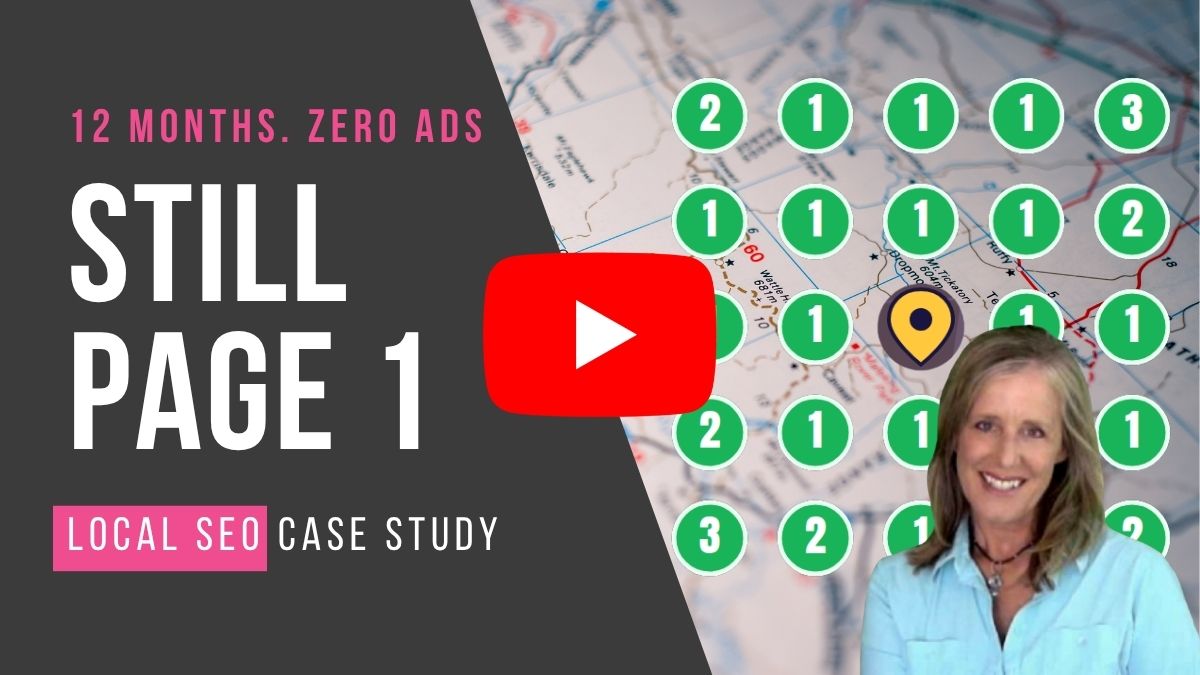
Quick Answer: This local SEO case study follows evidential psychic medium Cheryl Murphy, whose Google Business Profile sits in Palmdale, California, while her ideal clients live about an hour away in Los Angeles, Santa Monica, Manhattan Beach, Beverly Hills, and Encino. Instead of trying to stretch her map pack reach to cover those cities (it can’t be done), I built organic, town-specific content around the exact places and keywords her clients search. The result: map pack spots in Palmdale, Los Angeles, and Beverly Hills, multiple page 1 organic listings per search across Los Angeles, and bonus rankings on Bing. The best part: I stopped working on her site in October 2025, and in September 2026 her rankings are still holding with zero paid ads. Her organic traffic, keyword count, and backlinks actually grew over the past month. The only thing that faded was her AI Overview visibility.
What’s covered in this post:
- The challenge: a Palmdale profile with a Los Angeles clientele
- Where the clicks go: map pack vs. organic vs. paid ads
- The strategy: income-first town targeting and the right niche keyword
- The results, search by search
- How we did it: the service area business SEO framework
- What happened when the SEO work stopped
- Who this strategy works for
I’ve been doing SEO since 1999, and I’ll tell you what I tell every local business owner who asks where to start: getting found locally is the lowest-hanging fruit in digital marketing. When I opened my agency in 2009, local SEO was where I could hit a home run for nearly every client I took on. That hasn’t changed.
But here’s the question every business owner quietly asks before they invest: does it last? SEO takes time to build. What happens to those rankings when you stop paying someone to do the work?
This local SEO case study answers that with a real client and real screenshots. I started working with psychic medium Cheryl Murphy in mid 2025. We wrapped up our work together in October 2025. Almost a year later, I went back and ran the same searches to see what held. Spoiler: nearly all of it did.
Watch the full video walkthrough below, or keep reading for the breakdown, the strategy behind it, and the framework you can apply to your own business.

The Challenge: A Palmdale Profile, a Los Angeles Clientele
Cheryl Murphy is an evidential psychic medium and healer. If you’ve never worked with one, an evidential medium brings through specific, verifiable details from loved ones who’ve passed, the kind of detail that makes a skeptic sit up straight. She’s exceptional at it, and her sessions are premium-priced to match.
Her Google Business Profile is registered in Palmdale, California. Palmdale sits in the Antelope Valley in the far northern reach of Los Angeles County, a good hour’s drive from the Westside neighborhoods where most of her ideal clients live.
That created two problems at once:
- The market problem. Southern California is saturated with psychics. National brands like California Psychics spend heavily on advertising, and directories like Yelp and Reddit threads dominate the top of nearly every search.
- The distance problem. Google’s map pack leans hard on proximity. If someone searches for a psychic medium in Santa Monica, Google wants to show them a business in or near Santa Monica. A Palmdale profile, no matter how well optimized, starts at a real disadvantage for anything an hour away.
So the goal wasn’t just “rank Cheryl on Google.” It was: get Cheryl found by clients who can afford her, in cities her Google Business Profile was never going to reach on its own.

Where the Clicks Go: Map Pack vs. Organic vs. Paid Ads
Before the strategy, a quick look at why this matters so much.
According to a Google representative speaking at a local search conference, 46% of all Google searches have local intent. Almost half of everything people type into Google is someone looking for a business, service, or place near them.
And when a local search results page loads, the clicks don’t spread out evenly. A widely cited click study of local results found this split:
| Section of the Results Page | Share of Clicks |
|---|---|
| Google Map 3-pack | 44% |
| Organic results | 29% |
| Paid ads | 19% |
| “More local results” link | 8% |
Inside the map pack, position one earned about 17.8% of clicks, with positions two and three close behind at roughly 15% each. That means you don’t have to be number one on the map. Being anywhere in those three spots puts you in front of a huge share of searchers.
Organic results matter too. The first organic spot tends to earn about twice the clicks of the second, so page 1, and specifically the top three, is where the traffic lives.
Now look at paid ads. They pull roughly one in five clicks, and you pay for every single one of them, forever. The moment your ad budget stops, so does the traffic. That’s the heart of the SEO vs. Google Ads question: ads rent visibility, SEO builds it. Keep that in mind when you get to the part of this case study where the work stopped.
The Strategy: Income-First Town Targeting and the Right Niche Keyword
Income-first town targeting
Most local SEO starts with “what town is the business in?” I started with a different question: where do Cheryl’s ideal clients actually live, and can they afford her?
I pulled income data for Palmdale, Los Angeles, Beverly Hills, Santa Monica, and other Westside and Valley communities. Palmdale gives her a home-base market, but the clients who can comfortably book premium sessions are concentrated in higher-income areas. So we chose about six target cities with above-average household incomes, including Los Angeles, Santa Monica, Beverly Hills, and Encino, and built her visibility there.
This is the step most local SEO skips. Ranking for a town full of people who will never book you is a vanity win. Ranking where your best-fit clients live is a revenue win.
The right niche keyword, not just the biggest one
“Psychic medium” is the high-volume phrase, and we targeted it. But the phrase that describes Cheryl best is “evidential medium.” Fewer people search for it, but the people who do know exactly what they’re looking for, and there’s far less competition for it.
That choice paid off more than any other single decision in this project. As you’ll see in the results, evidential medium searches are where Cheryl lands at the very top, map pack included, in cities she doesn’t even live in.
Map pack for home base, organic content for everywhere else
The plan split into two tracks. In Palmdale, where proximity works in her favor, we went after the map pack with a fully optimized Google Business Profile (the full playbook is in Post 3: “optimize your profile”). For every target city beyond her profile’s realistic radius, we built organic content: dedicated, genuinely unique pages for each city, plus blog posts answering the questions her clients actually ask.
The Results: Page 1 Across Los Angeles, Search by Search
Here’s where Cheryl ranked when I re-ran these searches on September 22, 2026, almost a year after our last round of work. No paid ads on any of them.
| Search | Engine | Where Cheryl Shows Up |
|---|---|---|
| psychic medium palmdale ca | #2 in the map pack, #2 organic (behind Yelp) | |
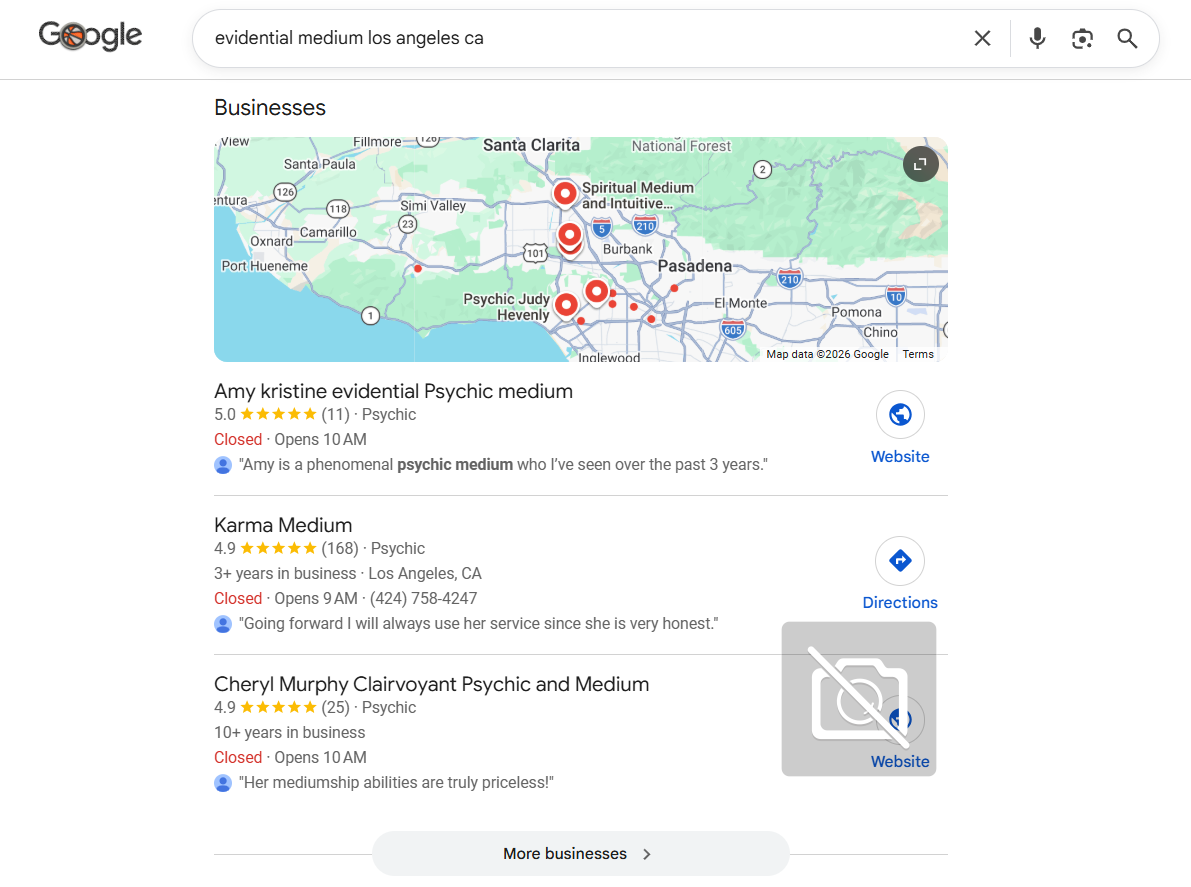
| evidential medium los angeles | #1 organic, #2 in the map pack, plus a second page 1 listing at #4 | |
| evidential medium los angeles | Bing | #1 on the map, #1 organic |
| psychic medium los angeles | #4 organic (behind Yelp and Reddit) | |
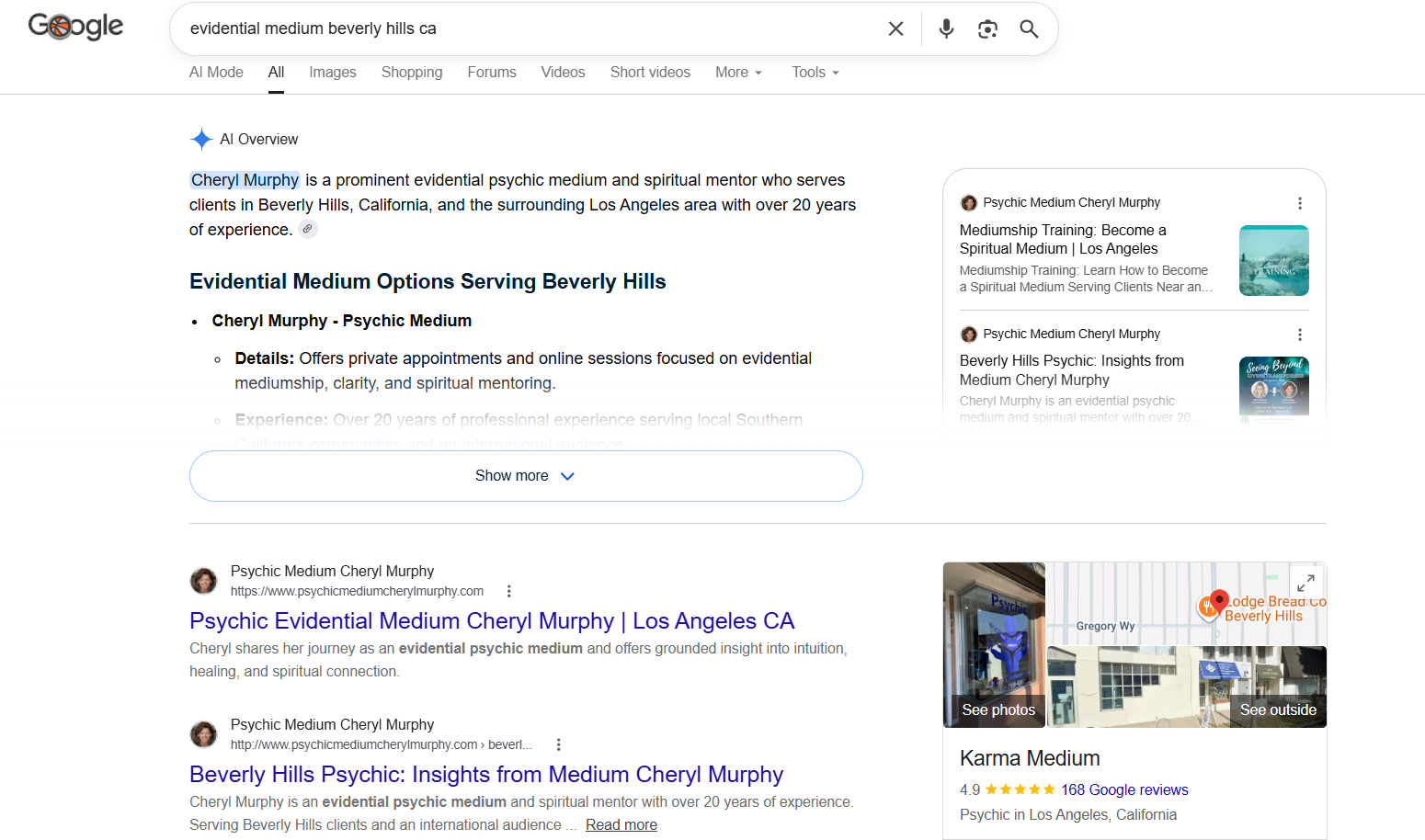
| evidential medium beverly hills | #3 in the map pack, #1 and #2 organic, plus her About page: four listings on page 1 | |
| evidential medium santa monica | #1 organic, with a second page 1 listing | |
| evidential medium santa monica | Bing | #1 on the map, #2 organic |
| psychic medium santa monica | #4 organic | |
| psychic medium encino | #3 organic, with a second page 1 listing | |
| psychic medium encino | Bing | On the map, #1 organic |
| spiritual readings los angeles | #2 organic | |
| psychic readings los angeles | #3 organic | |
| animal communicator santa monica | #3 organic | |
| animal communicator los angeles | #4 organic | |
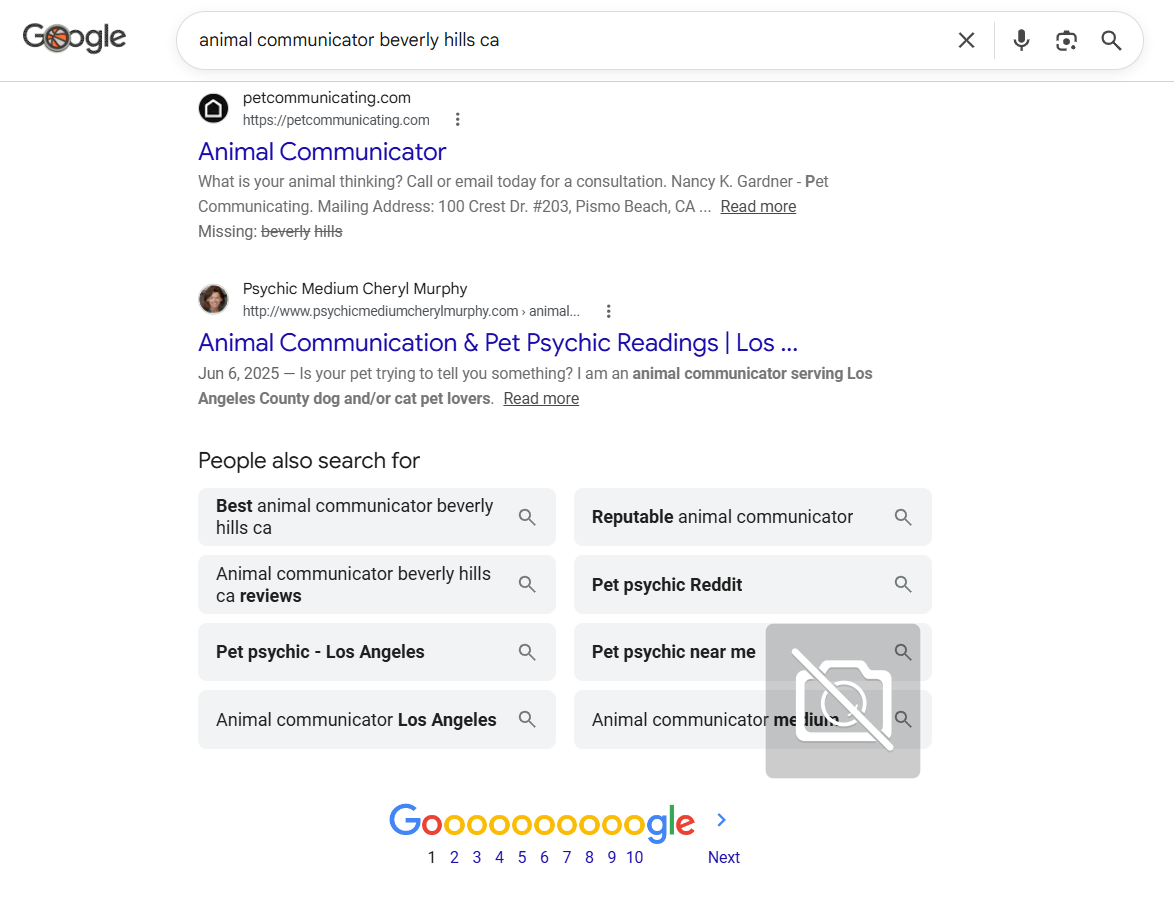
| animal communicator beverly hills | Page 1 organic, from a single blog post |
A few things worth pointing out:
- She’s in the map pack in cities she doesn’t live in. Proximity usually decides the map, which makes the Los Angeles and Beverly Hills map spots genuine exceptions. Strong, city-specific content and a niche keyword are what earned them.
- She owns multiple spots on the same page. For “evidential medium beverly hills,” Cheryl holds four positions on page 1: a map spot, her homepage, her Beverly Hills page, and her About page. Every extra listing pushes a competitor further down.
- She’s beating the directories where it counts. Yelp, Reddit, and big psychic networks dominate these results. An individual practitioner with real authority can still outrank them, and people often skip the directory listing to go straight to a real person.
- Bing came along for free. I never optimized for Bing specifically. Good SEO fundamentals carried over anyway, including two number one map spots.
And in the spirit of honesty: not every search is a win. For “psychic medium beverly hills” on Google, a more competitive phrase than its evidential medium cousin, Cheryl doesn’t show up at all. That’s real, and it’s exactly why the niche keyword strategy mattered so much.
How We Did It: The Service Area Business SEO Framework
Service area business SEO comes down to one idea: your Google Business Profile has a geographic ceiling, and organic content is how you break through it. Here’s the framework behind Cheryl’s results, and it’s the same one I use for clients in Colorado’s mountain towns.
1. Win the map pack where proximity is on your side
Start with your home base. A complete, optimized Google Business Profile is your best shot at the map pack in the town where you’re registered. For Cheryl, that meant Palmdale. If you haven’t set yours up yet, [Post 1: “what a Google Business Profile is”] walks you through it.
2. Build one location page per target city, and make each one genuinely different
Location pages SEO is where most businesses go wrong. They copy one page, swap the city name, and wonder why nothing ranks. Google filters out templated pages. Each of Cheryl’s city pages speaks to that specific community, with its own content, context, and reason to exist.
3. Research the exact city and neighborhood phrases your clients use
You can’t point a page at “psychic medium near me” and expect it to rank in a town you’re not in, because Google localizes “near me” to the searcher. But explicit city names are fair game. That’s how you rank in multiple cities: target the phrase with the place name in it. The full method is in [Post 4: “local keyword research”].
4. Publish content that answers what those searchers actually ask
One blog post about animal communication, connecting with a beloved pet in spirit, now ranks on page 1 in Los Angeles, Manhattan Beach, and Beverly Hills. Helpful, specific content reaches searchers your service pages never will.
5. Give every page its own job
Look back at the results table. Different searches land on different pages: her homepage, a city landing page, her About page, a blog post. That’s by design. When every page and post is unique, Google can match the best one to each search, and you can hold several spots on the same results page.
6. Build authority with backlinks
When another website links to one of your pages, it tells Google that page is worth trusting. Cheryl’s backlinks keep growing, and that authority lifts every page on her site.
What Happened When the SEO Work Stopped
This is the part I most wanted to see for myself. Cheryl stopped paying for SEO in October 2025. No new content, no ongoing optimization, no ads. Here’s what I found in September 2026:
- Her rankings held. Map pack spots and page 1 organic rankings across Los Angeles are still there, nearly a year later.
- Her organic numbers went up. Organic traffic, organic keywords, and backlinks all increased over the past month, on their own.
- Her AI Overview visibility faded. While we were actively working, Cheryl appeared in Google’s AI Overviews and in the image panel beside them. Those mentions have dropped off. AI search rewards fresh, active content, and a site that goes quiet eventually loses that edge.
So how long does local SEO take? Expect to put in steady work for several months before rankings settle, depending on your competition. But here’s what this case study shows: once solid rankings are built, they don’t vanish the day the work stops. That’s the real difference between SEO and paid ads. An ad campaign disappears the moment you stop paying for it. SEO keeps working for you.
The honest caveat: holding isn’t the same as growing. If Cheryl wanted her AI Overview spots back, or wanted to break into “psychic medium beverly hills,” that takes ongoing work. Maintenance keeps you in the game. New content moves you forward.
Who This Strategy Works For
Cheryl is a psychic medium, but nothing about this framework is psychic-specific. It works for any service based business whose ideal clients don’t all live next door to the business address:
- Holistic practitioners and healers whose best clients live in a wealthier town nearby.
- Coaches and private practices who see clients in person across several communities.
- Wellness businesses in resort and mountain towns, where a Google Business Profile in one town rarely reaches the next valley over.
- Home-based and service area businesses that hide their address and serve clients across a region.
That last group is my backyard. In Colorado’s Roaring Fork Valley and Vail Valley, a business in Carbondale won’t naturally show up on the map for someone searching in Aspen, and a practitioner in Edwards won’t reach Vail on the map alone. It’s the exact challenge Cheryl faced, just with ski lifts instead of freeways. I break down how it plays out in each valley in [Coming soon: Post 10: “Roaring Fork Valley”] and [Coming soon: Post 11: “Vail Valley”], and how it applies to a bigger, more competitive market in [Coming soon: Post 9: “Boulder”].
And if you want the bigger picture of how the map pack works, start with my pillar post: “the local SEO playbook” and Post 2: “why the 3-pack matters”.
FAQs
How long does local SEO take to work?
Plan on several months of steady work before rankings settle, longer in competitive markets. Map pack gains in your home town often show up first. Organic rankings in cities beyond your map radius take longer because you’re building authority from content, not proximity. The upside, as this case study shows, is that well-built rankings can hold for a long time afterward.
Can I rank in a city where I don’t have a Google Business Profile?
Yes, organically. You won’t usually compete for the map pack in a city far from your registered address, though Cheryl’s Los Angeles and Beverly Hills map spots show it isn’t impossible with a strong niche keyword. Page 1 organic visibility is very achievable with genuinely useful, city-specific content.
Is local SEO better than Google Ads?
They do different jobs. Ads buy instant visibility for as long as you pay. Local SEO builds visibility that keeps working after the work stops. In local search, the map pack and organic results together earn most of the clicks, while paid ads get roughly one in five. For most local service businesses, SEO is the better long-term investment, with ads as an optional boost.
What happens to my rankings if I stop doing SEO?
Solid rankings usually don’t disappear overnight. Cheryl’s map pack and page 1 rankings held for almost a year with no ongoing work, and her organic traffic kept growing. What faded was her AI Overview visibility, which rewards fresh content. Stopping means holding, not growing.
Do I need a separate page for every city I serve?
If you want to rank in that city, yes, and each page needs genuinely unique content. Swapping the city name on a copied page rarely works. Start with the cities where your best-fit clients actually live, not every town you could drive to.
Does local SEO work for psychics, healers, and coaches?
Absolutely. Practitioners often have an advantage: specific niche terms like “evidential medium” or “energy healer” face far less competition than broad terms, and a real individual expert can outrank the big directories.
Want to See Where You Stand in Your Town?
Cheryl’s results didn’t come from luck or a bigger ad budget. They came from knowing exactly where her clients were searching and putting a stake in the ground there.
Your free Google Business Profile Visibility & Map Ranking Audit shows you where you show up on the map across your service area, how your profile scores, and the single biggest visibility gap standing between you and the clients already searching for you. No guesswork, no overwhelm, just results.
Sources & Citations
1. Search Engine Roundtable: Did Google Say 46% Of Searches Have Local Intent?
https://www.seroundtable.com/google-46-of-searches-have-local-intent-26529.html
Reports a Google representative’s statement at a 2018 local search conference that 46% of searches carry local intent.
Supports: the “Where the Clicks Go” section’s 46% local-intent figure.
2. BrightLocal: Local SEO Statistics
https://www.brightlocal.com/resources/local-seo-statistics/
Verified local SEO statistics roundup confirming the 46% figure’s origin at a Google presentation.
Supports: the “Where the Clicks Go” section’s 46% local-intent figure.
3. Oneupweb: Decoding Local Search Results, the Map Pack and More
https://www.oneupweb.com/blog/local-search-results-map-packs/
Summarizes the 44% map pack, 29% organic, and 19% paid click split, and notes the top organic result tends to earn about twice the clicks of the second.
Supports: the click-share table and organic click commentary.
4. Red Local Agency: Google Local Pack Statistics
https://www.redlocalagency.com/google-local-pack-statistics/
Lists per-position map pack click-through rates of 17.8%, 15.4%, and 15.1%, plus the 8% “more local results” share.
Supports: the map pack position breakdown.
Discover more from The Athena Arena with Liz Gracia
Subscribe to get the latest posts sent to your email.

Leave a Reply