Quick Answer: Service area business SEO is the work of getting found in every town you serve, not just the town on your Google Business Profile. Google’s map pack leans heavily on how close a business is to the person searching, so a profile registered in one town rarely (though not impossible depending on where you live) shows up on the map an hour away, no matter how well it’s optimized. The fix is organic: a genuinely unique page for each town you want to reach, built around the exact searches people type there, supported by service pages, helpful content, and local mentions. That’s how my clients rank on page 1, and often at #1 organic, directly below a map pack they aren’t in.
What’s covered in this post:
- Why your Google Business Profile can’t cover every town you serve
- Proof: two businesses ranking where they don’t live
- The service area business SEO framework, step by step
- What a strong location page looks like (and what Google treats as spam)
- Who needs this strategy
- Map pack vs. organic: which to prioritize first
- How long it takes
- FAQs
If you run a service area business, you’ve probably had this moment. You search for your own service in a town you work in every week, and you’re nowhere. The map shows three competitors who happen to be based closer. Below them sits a directory, or a business from another state.
You’re not doing anything wrong. You’ve hit the limit of the map pack, and it’s the most common local SEO problem I see. It’s also the question I get asked most about my local SEO playbook: what do you do when you can’t win the map pack?
Here’s the shift that changes everything. Your map pack visibility is rented from your address. Your website is something you own. You can’t move your office, but you can move your website into every town you serve.
And the map pack isn’t the only real estate on page 1. In a widely cited local search click study, 44% of searchers clicked a map pack result, but 29% clicked an organic result right below it (Red Local Agency). Those organic listings care far less about where your office is. That’s where service area business SEO does its work.
I’ve used this framework for a psychic medium whose profile is in Palmdale, California, but whose clients live across Los Angeles, and for a Colorado roofer with offices in Glenwood Springs and Eagle whose best clients live in Aspen and Vail. Both now rank on page 1 in towns where they don’t have an address. Here’s how.

Why Your Google Business Profile Can’t Cover Every Town You Serve
Google says local results are based mainly on three things: relevance, distance, and prominence. Distance means exactly what it sounds like: how far your business is from the person searching (Google Business Profile Help). That’s one important limit of any Google Business Profile. You can sharpen relevance and build prominence, but you can’t move your address closer to the searcher.
The experts agree. In Whitespark’s 2026 Local Search Ranking Factors survey of 47 local SEO specialists, proximity to the searcher ranked #2 for map pack rankings, just behind your primary business category. “Physical address in the city of search” ranked #4, and “address showing on your profile (not a service area business)” ranked #7 (Whitespark).
Read that last one again. If you’re a service area business that hides its address, as Google asks you to when you don’t serve customers at your location, you start the map pack race a few steps behind (Google’s Business Profile guidelines). That’s the 3-pack’s geographic limit, and no amount of profile optimization removes it.
Setting a service area doesn’t make you rank there
This one surprises a lot of owners. Google lets a service area business list up to 20 service areas by city or ZIP code, and the overall area shouldn’t extend more than about two hours’ drive from where you’re based (Google Business Profile Help). But listing a town tells customers where you work. It doesn’t put you in that town’s map pack (though it could!?! It depends on where you live and the business you are in.)
So if your best clients live in a town where you don’t have an address, the map isn’t going to get you there. Your website has to.
Proof: Two Businesses Ranking Where They Don’t Live
Psychic Medium Cheryl Murphy: a Palmdale profile, a Los Angeles clientele
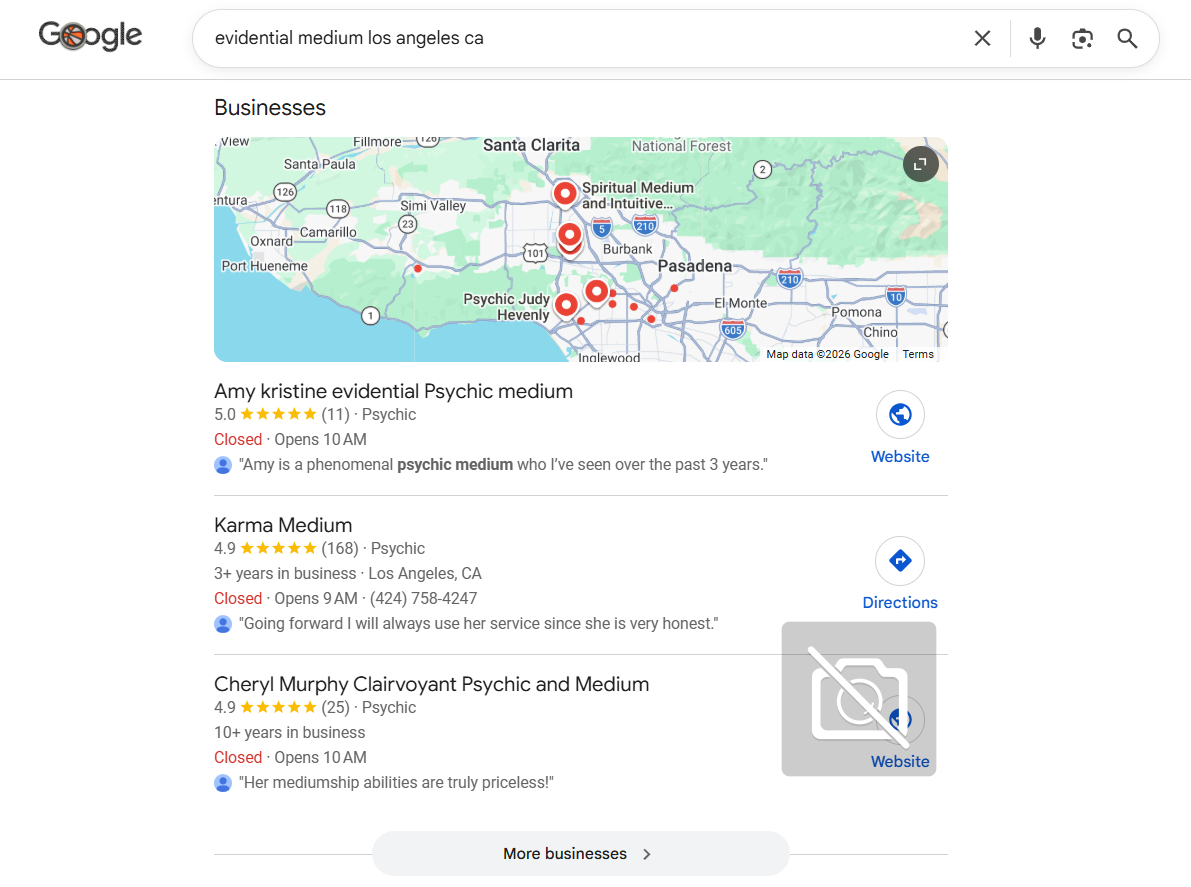
Cheryl Murphy is an evidential psychic medium whose Google Business Profile is registered in Palmdale, in the far northern reach of Los Angeles County. Her ideal clients live about an hour away in Santa Monica, Beverly Hills, Encino, Manhattan Beach, and across Los Angeles. A map pack strategy alone could never reach them.
So we split the work into two tracks. In Palmdale, where proximity is on her side, we went after the map pack. For every target city beyond her profile’s realistic radius, we built organic content: a genuinely unique page for each city, plus blog posts answering the questions her clients actually ask. We also leaned on a niche phrase, “evidential medium,” which faces far less competition than “psychic medium.”
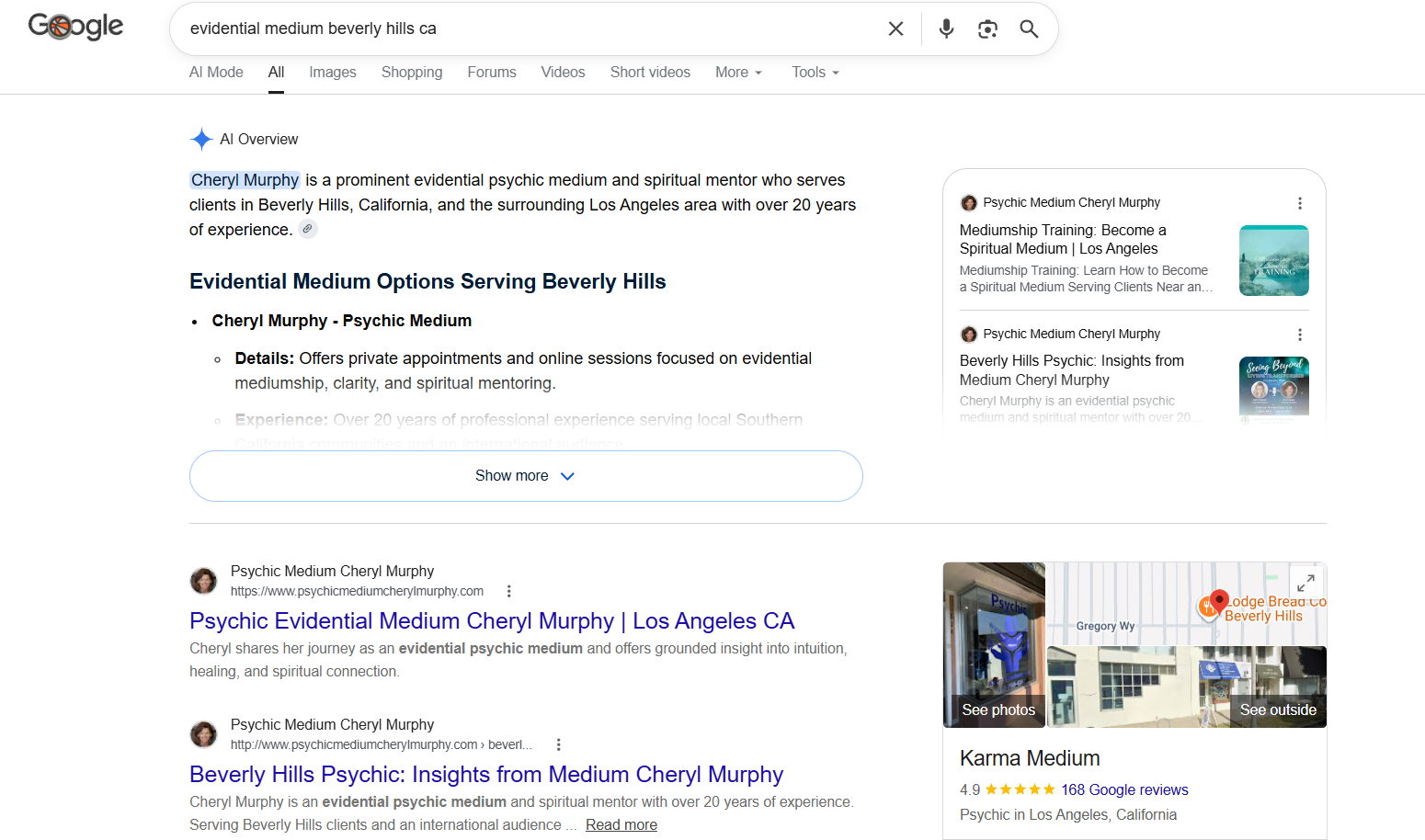
When I re-ran her searches in September 2026, almost a year after we stopped working together, here’s a sample of what held, with zero paid ads:
| Search | Where Cheryl shows up |
|---|---|
| psychic medium palmdale ca | #2 in the map pack and #2 organic |
| evidential medium los angeles | #1 organic, #2 in the map pack, plus a second page 1 listing |
| evidential medium beverly hills | Four listings on page 1, including #1 and #2 organic |
| evidential medium santa monica | #1 organic, with a second page 1 listing |
| psychic medium encino | #3 organic, with a second page 1 listing |
The full search-by-search breakdown, including what didn’t work, is in the Cheryl Murphy case study.
Umbrella Roofing: offices in two towns, clients in four others
Umbrella Roofing has offices in Glenwood Springs and Eagle, Colorado, where commercial rent makes sense. Their highest-value clients are in Aspen, Snowmass, Vail, and Beaver Creek. I built close to two dozen new landing pages for them, organized by service, by partner type, and by community.
Within weeks of Google reindexing the site, Umbrella was ranking #1 organically for searches like “roof repair Aspen,” “roof replacement Aspen,” and “roof replacement Vail,” without being in the map pack for any of those towns. For “roof replacement Vail,” the map showed competitors located closer to Vail, and Umbrella held the #1 organic spot directly below it. Every detail is in the Umbrella Roofing case study.
A psychic medium and a mountain roofer have almost nothing in common, except the problem: their best clients live where their address doesn’t. The fix was the same for both.
The Service Area Business SEO Framework, Step by Step
This is the framework behind both case studies. It’s also my answer whenever someone asks about SEO for multiple cities: you don’t stretch one page or one profile across a region. You give each town its own reason to rank.
Step 1: Choose your towns by client value, not by the map
Most local SEO starts with “Where is the business?” I start with “Where do your best clients actually live, and can they afford you?”
For Cheryl, I pulled income data for Palmdale and the Westside and Valley communities around Los Angeles, then chose about six cities with above-average household incomes. For Umbrella, the answer was the resort towns where homes, HOAs, and commercial properties carry the biggest roofing budgets.
Ranking in a town full of people who will never hire you is a vanity win. Ranking where your best-fit clients live is a revenue win. Think of this step as alignment work: you’re choosing the places where your best work and your best clients meet. Start with three to six towns and expand from there.
Step 2: Research the exact town phrases your clients type
Here’s the overlooked keyword opportunity for service area businesses. “Near me” searches are localized to the searcher, so a page can’t realistically target “roofer near me” in a town you’re not in. But searches with an explicit place name, like “roof repair Aspen” or “evidential medium Santa Monica,” are fair game for any business with a relevant, helpful page.
For each target town, build a short list of service-plus-town phrases. Expect small numbers. In mountain towns and smaller suburbs, SEMrush often shows little or no measurable volume for town-level searches, but the people typing them are usually ready to hire someone. One booked client from a “zero volume” keyword can be worth more than a thousand visits from a broad one.
Step 3: Build one genuinely unique location page per town
This is where location pages SEO succeeds or fails, and most businesses get it wrong. They copy one page, swap the city name, and wonder why nothing ranks.
Google is explicit about this. Its spam policies define “doorway abuse” to include “having multiple domain names or pages targeted at specific regions or cities that funnel users to one page” and “creating substantially similar pages that are closer to search results than a clearly defined, browseable hierarchy” (Google Search Central). Template pages with a city name swapped in are exactly what that policy describes.
A strong service area page has its own content, context, and reason to exist. I’ll show you what that looks like in the next section.
Step 4: Give every service its own page, then connect services to towns
In Whitespark’s 2026 survey, “dedicated page for each service” ranked as the #1 factor for local organic rankings (Whitespark). Content that names the cities and neighborhoods you serve also scored near the top.
In practice, that means:
- A page for each core service. Not one “Services” page listing everything.
- A page for each target town. Each one links to the services you offer there.
- Service pages that link back to towns. A roof repair page can mention and link to the Aspen and Vail pages where you do that work.
That web of internal links shows Google which services you offer in which places, and it helps visitors find the right page fast.
Step 5: Publish content that answers what each town is asking
Service pages and town pages answer “who does this here?” Blog posts and guides answer everything people ask before they get to that point.
For Cheryl, one blog post about animal communication, connecting with a beloved pet in spirit, ranks on page 1 in Los Angeles, Manhattan Beach, and Beverly Hills. For Umbrella, problem-focused pages about snow retention and ice dams answer the exact worries of mountain property owners, and those pages now show up in Google’s AI Overviews for searches like “snow retention roof Aspen.” If you’re curious about that side of things, here’s what AI search means for local SEO.
There’s a bonus here that most owners haven’t caught yet. AI tools are often more willing than the map to recommend a business that isn’t right next door. In BrightLocal’s 2026 study of more than 200,000 local AI searches, 90% of the businesses Google’s AI Overviews recommended were within about 24 miles of the searcher, but ChatGPT’s recommendations reached out to about 178 miles (BrightLocal). Clear, town-specific pages give those tools something solid to recommend you for.
When every page and post has its own job, Google can match the best one to each search, and you can hold more than one spot on the same results page. For “evidential medium beverly hills,” Cheryl holds four.
Step 6: Earn local mentions and links in your target towns
When another website links to yours, it signals that your page is worth trusting. Links and mentions from websites in the towns you serve carry extra local weight.
For a service area business, the move is to earn mentions from the towns you want to reach, not just your home base:
- Local chambers of commerce and business associations in each target town
- Community events, nonprofits, or schools you support there
- Partners who work in those towns: builders, designers, property managers, venues, other practitioners
- Local press, podcasts, and “best of” lists
- Relevant directories, including niche directories for your industry
Step 7: Set up your Google Business Profile the right way for a service area business
Your profile still matters. It’s your best shot at the map pack near your home base, and it feeds information to Google’s AI features. Set it up by the rules:
- Hide your address if you don’t serve customers there. Google asks service area businesses to clear the address from the profile (Google’s guidelines).
- Hybrid businesses can show both. If you serve customers at your location and also travel to them, you can show your address and add a service area (Google Business Profile Help).
- List up to 20 service areas by city or ZIP code, within about two hours of your base.
- Don’t fake a local address. Google’s guidelines say virtual offices and remote mailboxes aren’t eligible. A shared workspace only counts if it has signage, receives customers, and is staffed during business hours. A fake address is one of the fastest ways to get a profile suspended.
Step 8: Track rankings town by town
You can’t judge results by searching from your own office, because Google personalizes local results by location. Use a rank tracker that lets you set the search location, check Google Search Console for which pages are earning impressions, and keep a simple list of your priority service-plus-town searches. Check them monthly.
Then ask every new client one question: “How did you find me?” Rankings tell you where you’re visible. That answer tells you which towns are actually paying off.
What a Strong Location Page Looks Like
Here’s the difference between a page that earns rankings and one Google is likely to ignore or filter out.
| A strong service area page | A doorway page |
|---|---|
| Written for that town’s clients, with details that only apply there | Copied from another town page with the city name swapped |
| Names real neighborhoods, landmarks, and local conditions (snow loads in Aspen, traffic patterns in LA) | Repeats the town name five times with no local substance |
| Shows work, projects, or clients from that town, with permission | Uses the same photos and testimonials as every other page |
| Answers questions people in that town ask | Answers nothing specific |
| Links to relevant service pages and back to your main site | Funnels every visitor to one contact page |
| Exists because you actually work there | Exists only to catch a search |
A useful test: if you deleted the town name from the page, could a reader still tell which town it was written for? If not, it needs more work.
A simple outline for each service area page:
- A headline with your service and the town (for example, “Roof Repair in Aspen and Snowmass”)
- An opening paragraph that answers the main question right away: what you do there, who you serve, and how to reach you
- Local context: the conditions, building types, client needs, or neighborhoods specific to that town
- Services you offer there, each linked to its own service page
- Proof from that town: a project, a review, or a client story
- FAQs people in that town actually ask
- A clear next step
Who Needs This Strategy
Local SEO for service area businesses pays off whenever your ideal clients live outside your Google Business Profile’s realistic map radius. That usually means one of these:
- You travel to clients. Roofers, contractors, cleaners, landscapers, mobile practitioners, and in-home service providers who hide their address.
- Your office is where rent is affordable, and your clients are somewhere else. Mountain trades in Glenwood Springs or Eagle serving Aspen and Vail. Practitioners in the suburbs serving a wealthier town nearby.
- You serve a whole region. Coaches, consultants, therapists, and wellness providers who see clients in person across several communities.
- You offer a niche or premium service. When there are only a handful of providers like you, people will drive farther, and they’ll search by town name to find you.
This is the daily reality in Colorado’s mountain valleys. A business in Carbondale won’t naturally appear on the map for someone searching in Aspen, and a practitioner in Edwards won’t reach Vail on the map alone. I walk through how this plays out in the Roaring Fork Valley and the Vail Valley in separate posts.
Map Pack vs. Organic: Which to Prioritize First?
You don’t have to choose one forever, but you do have to sequence the work. Here’s how I decide.
| Your situation | Start with | Then layer in |
|---|---|---|
| Your home-base town is also a priority market | Map pack: claim, verify, and fully optimize your profile, and earn reviews | Organic town pages for every other target town |
| Your best clients are mostly an hour or more away | Organic: service pages and town pages for your top three to six towns | Map pack work for your home base |
| You have no website, or only a homepage | Website foundation: service pages first | Town pages, then content and local links |
| You have a brand-new or unverified profile | Claim and verify now (map rankings take months) | Organic pages at the same time |
The short version: pursue the map pack where proximity works in your favor, and use organic, town-specific content for every location beyond that radius.
How Long Service Area Business SEO Takes
It depends on your competition and how much work your site needs, but here’s what I’ve seen.
- Indexing can be fast once Google knows your site is active. Umbrella’s new pages began appearing in search within about three days of resubmitting the site in Google Search Console, after years of the site sitting untouched. Several were ranking #1 within about four weeks.
- Competitive markets take longer. For Cheryl, in one of the most crowded markets in the country for her work, rankings took several months of steady work to settle.
- Good rankings tend to hold. Cheryl’s rankings were still in place almost a year after our work ended, and her organic traffic kept growing. What faded was her visibility in AI Overviews, which seem to reward fresh, active content.
- Map rankings are slower. Expect three to six months for a newly claimed profile to start competing, and know it will always be harder in towns where you don’t have an address.
Frequently Asked Questions
Can I really rank #1 organically in a city where I don’t have a Google Business Profile?
Yes. Organic results rank websites, not profiles, so a genuinely useful page for that city can rank at the top without a local address. Umbrella Roofing ranks #1 organically for “roof repair Aspen” from offices in Glenwood Springs and Eagle, and Cheryl Murphy ranks #1 for “evidential medium santa monica” from a profile in Palmdale.
How long does organic service area ranking take compared to map pack ranking?
Organic rankings for town-specific pages can appear within weeks once Google indexes them, as they did for Umbrella Roofing. Competitive markets take several months. Map pack rankings for a newly claimed profile usually take three to six months, and in towns far from your address they may never come.
Do I need a separate page for every town, or can one page target several?
For your priority towns, give each one its own page with unique content. One page can cover a tight cluster of neighboring towns, such as Aspen and Snowmass or Vail and Beaver Creek, if the clients, conditions, and services really are the same. What doesn’t work is a single page listing 30 towns, or 30 near-identical copies.
Should a service area business hide its address on Google?
If you don’t serve customers at your address, yes. Google asks service area businesses to hide it. If customers do visit you and you also travel to them, you’re a hybrid business and can show both your address and your service area.
Does adding a town as a service area on my Google Business Profile help me rank there?
Not much on its own. Your service areas tell customers where you work, but Google still weighs distance heavily for the map pack. Organic town pages are what get you ranking in towns beyond your radius.
Is SEO for multiple cities the same as local SEO for multiple locations?
Not quite. Local SEO for multiple locations usually means a business with several staffed offices, each with its own Google Business Profile. SEO for multiple cities, the focus of this post, means one business ranking in several towns it serves from a single base. The location page principles overlap; the profile setup is different.
Can I rent a virtual office in a town to get into its map pack?
No. Google’s guidelines say virtual offices and remote mailboxes aren’t eligible for a Business Profile, and coworking offices only count if they have signage, receive customers, and are staffed during business hours. It’s a common shortcut, and it can get your profile suspended.
Ready to Rank in the Towns Where Your Best Clients Live?
If your Google Business Profile is doing its job close to home, but your phone isn’t ringing from the towns that matter most, this is the gap I fix. I’ve been doing SEO since 1999, I’ve lived in Colorado’s Roaring Fork Valley since 2004, and I work with service area businesses here in the mountains and across the country.
Book a free 30-minute consultation and we’ll look at where you’re showing up now, which towns are worth targeting first, and what it would take to get you there. You can also learn more about my local SEO services.
Not ready to talk yet? Start with a free map visibility audit at theathenaarena.com/localseo. I’ll show you where you rank across your service area and review the results with you personally.
Discover more from The Athena Arena
Subscribe to get the latest posts sent to your email.
