
Quick Answer: The Google Map 3-pack is the block of three business listings, with a map, that Google shows above every organic result on a local search. It appears on the vast majority of local searches and pulls close to half of all clicks on the page, which is why it beats ranking #1 organically almost every time. Google decides who’s in it based on distance, profile completeness, and reviews, and that distance factor means a perfectly optimized profile still can’t win the pack in a town it isn’t physically close to. That’s a hard limit, not a fixable tactic, and it’s exactly the gap that town-specific content is built to close.
What’s covered in this post:
- What the Google Map 3-pack actually is and where it shows up
- Why the 3-pack beats ranking #1 organically, with the numbers behind it
- How Google decides who gets one of the three spots
- The 3-pack’s geographic limit, and a real client example of what that looks like
- What’s below the 3-pack on the page, and why it still matters
You’ve seen it a hundred times without ever knowing it had a name. Three business listings, a little map, sitting right at the top of the page above every organic result. That’s the Google Map 3-pack, and if you’ve read [LINK: pillar post — “the local SEO playbook”] and [LINK: Post 1 — “what a GBP is and how to claim it”], you already know your Google Business Profile is what gets you eligible for it. This post is where I explain why that spot is worth fighting for in the first place.
Here’s what we’re covering: what the 3-pack actually is, why it beats a #1 organic ranking almost every time, the three levers Google uses to decide who gets a spot, where the 3-pack’s reach hits a hard wall no amount of optimization can fix, and what’s sitting below it on the page. I’ll also walk through a client of mine who couldn’t be found anywhere online, and what that told me about how winnable this actually is.

What Is the Google Map 3-Pack?
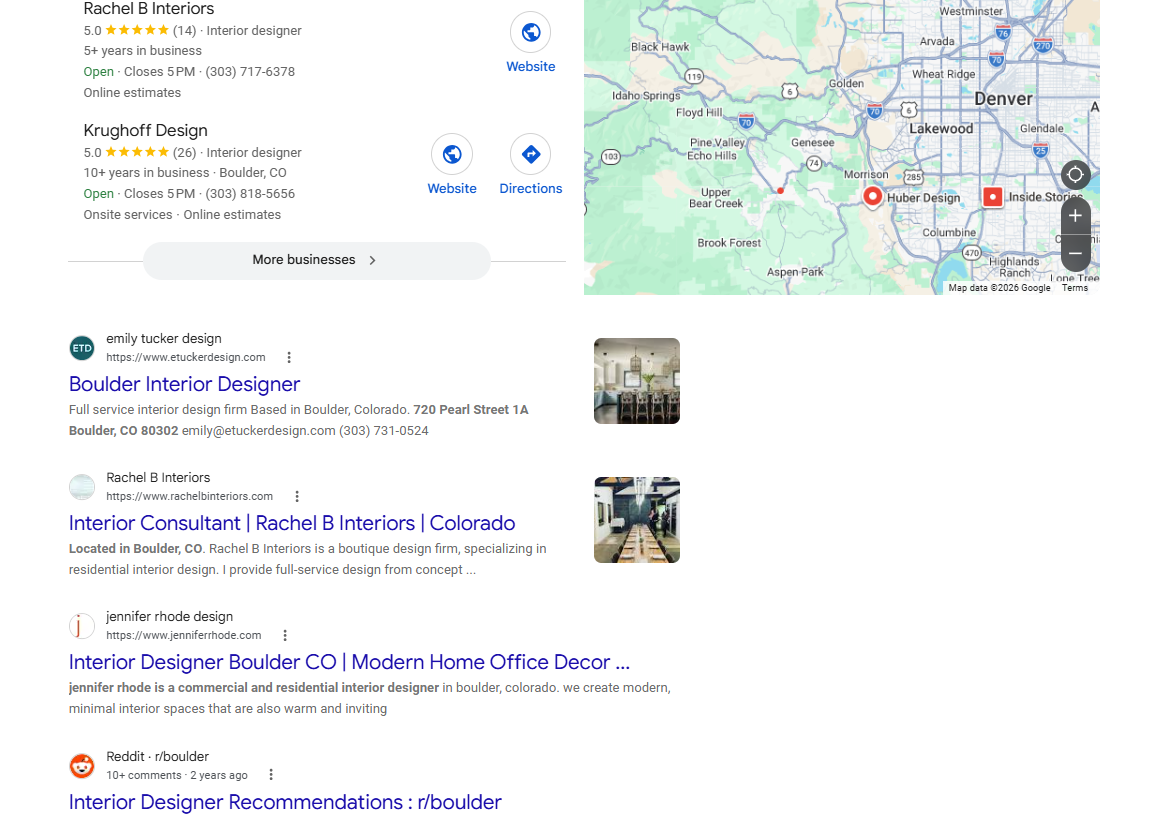
Search anything with a local intent, “life coach near me,” “energy healer Carbondale,” “roofing contractor Basalt,” and before you ever scroll to a blue link, Google shows you three business listings sitting inside a box with a small map. Each one shows a name, star rating, review count, hours, and a click-to-call button. That’s the 3-pack, also called the map pack or the local pack, and it’s the single most valuable piece of real estate on a local search results page.
It’s not an ad. Nobody pays to be in the 3-pack directly. It’s generated from Google Business Profile data, matched against what Google believes best answers the searcher’s question. That’s exactly why getting your profile right, the work covered in [LINK: Post 1] and [LINK: Post 3], is what puts you in the running for one of these three slots in the first place.
Local search, click share by result type
The map pack wins before anyone scrolls
On a search with local intent, here's roughly where the clicks land, the 3-pack, the organic listings below it, and paid ads.
Position 1 alone pulls about 17.6% of all clicks on the page.
Everything below the map pack, blue links and beyond.
Costs money for every one of those clicks, pack and organic don't.
Figures reflect commonly reported industry ranges (Moz, Backlinko, First Page Sage, 2026). Remaining clicks go to other local pack variations and page features. theathenaarena.com
Why the 3-Pack Beats Ranking #1 Organically
This is the part where I lose people to SEO jargon if I’m not careful, so let me put it the way I actually put it to clients: those three spots aren’t just visible, they’re where the clicks go. The Google 3-pack shows up on the large majority of local searches, and it’s almost always sitting in the top position on the page. It pulls somewhere in the neighborhood of 42-44% of all clicks on a local search, ahead of organic results below it and well ahead of paid ads. And within the pack itself, position still matters:
- the #1 spot pulls roughly 17.6-17.8% of clicks,
- #2 pulls about 15.4%,
- #3 pulls about 15.1%.
Here’s the moment that actually lands with a client,
not the definition of the 3-pack, the numbers. Every time I show a business owner what those click-through rates actually look like next to their current visibility, that’s when it clicks.
That’s especially true for the ones who haven’t claimed their profile at all, or who’ve been putting money into Google Ads every month without ever touching their Google Business Profile. Ads and a strong profile aren’t really competing strategies, they’re honestly six of one, half a dozen of the other in terms of what they can each do for you.
But ads stop the moment you stop paying.
A fully built-out profile keeps working, keeps compounding, and keeps showing up long after you’ve stopped actively thinking about it. That’s the argument for building it right the first time, even when it takes more up-front effort than turning on an ad campaign.

How Google Decides Who’s In It
Google names three core factors that decide who lands in those three spots: distance from the searcher, how complete and relevant your profile is, and reviews. I’m keeping this high-level here on purpose. The actual step-by-step on fixing your profile, category selection, filling out every field, photos, posts, all of it, lives in this post “How to Optimize Your Profile for the 3-Pack”.
What matters right here is understanding that two of those three levers, profile completeness and reviews, are entirely within your control. You can build them, improve them, and keep working them. The third, distance, is not something you can optimize your way around. And that limitation is worth its own section, because it’s the single biggest misunderstanding I run into with clients.

The 3-Pack’s Geographic Limit: Why You Can’t Win It Everywhere
Even a flawlessly built profile can only compete for the 3-pack in towns near its physical address. That’s not a tactic problem you can fix with more effort, it’s a ceiling built into how the system works. Distance is one of Google’s three named ranking factors, and no amount of category selection or review generation moves your listing closer to a searcher who’s four hours away.
I saw this play out recently with a roofing client of mine
who serves two separate mountain regions and, when we started, hadn’t even claimed either Google Business Profile. Searching for their own services, the only thing that showed up at all was their homepage, buried somewhere on page one or two of the organic results. No map pack presence. No profile. Nothing.
Here’s what actually told me this was winnable, and fast: when I looked at who was showing up in the 3-pack for their target searches, some of the businesses ranking weren’t even in the region. They were based in Denver, roughly four hours away. If a company with zero real proximity to the searcher can still land a map pack spot on an unclaimed, uncompeted-for field, that’s not a sign the competition is fierce. That’s a sign almost nobody local has bothered to do the basic work yet. My client wasn’t behind because the 3-pack was hard to crack. He was behind because he hadn’t shown up to the game at all.
Which points to the bigger opportunity here.
The distance limit cuts both ways. Yes, it means you can’t win the map pack in a town you’re not physically close to. But it also means that for the towns just outside your radius, or the niches too crowded to crack the top three at home, there’s often little to no competition for page-one, position-one-two-three organic results built around dedicated, town-specific content. Reaching searchers outside your map-pack radius is a separate, content-driven play.
What’s Below the 3-Pack?
Scroll past the map pack and you’ll find the organic listings, followed further down and at the very top by paid ads. Those spots still capture real traffic, position still matters there too, but they’re competing for a noticeably smaller slice of clicks than the pack sitting above them. That’s the whole case for treating the 3-pack as the priority rather than an afterthought once you’ve handled “regular” SEO.
It’s also why organic content still matters even when you’ve locked down your 3-pack presence at home. That organic real estate is exactly where town-specific, service-specific content picks up the slack in every community your map pack radius can’t reach.
FAQs
How many businesses show in the map pack?
Three. That’s the whole game, which is exactly why the spots are worth fighting for. Google occasionally tests variations, but the standard experience shows three listings above the organic results.
Can paid ads appear in the 3-pack?
No. The 3-pack itself is unpaid and generated from Google Business Profile data. Paid local ads can appear above or near it depending on the search, but they’re a separate placement, not a way to buy your way into one of the three organic map spots.
Why doesn’t my business show up in the map pack for a nearby city?
Distance. Even a fully optimized profile is competing hardest in the area immediately around its physical address, and Google’s own ranking factors name distance as one of the three core signals. If you need visibility in a town outside that radius, that’s a content strategy, not a profile-tweaking one.
Want to Know Where You Actually Stand?
Now you know what the 3-pack is, why it beats page one, and where its reach stops. The next question is simple: are you in it right now, for the searches that actually bring you business? Most owners have never checked, and plenty who have claim a profile find out it’s been sitting incomplete for months. A Free Google Business Profile & Map Ranking Audit gives you a real answer, exactly where your listing stands, what’s keeping you out of the pack, and what it would take to get in. No pitch, no pressure.
Sources & Citations
Click-through and appearance-rate figures for the local 3-pack vary somewhat by research firm and methodology. The figures used in this post reflect the most commonly reported ranges across current industry sources as of 2026.
1. Google Business Profile Help — Improve your local ranking on Google
https://support.google.com/business/answer/7091?hl=en
Google’s official explanation of the three local ranking factors, relevance, distance, and prominence.
Supports: “How Google Decides Who’s In It” and the geographic limit section.
2. Moz — Local Search Ranking Factors
https://moz.com/local-search-ranking-factors
Industry research on local pack appearance rate and click share on local-intent searches.
Supports: the “Why the 3-Pack Beats Ranking #1 Organically” section.
3. First Page Sage — Google Map Pack Click-Through Rates
https://firstpagesage.com/seo-blog/google-map-pack-click-through-rates/
Position-by-position CTR data for the three map pack slots.
Supports: the position-level CTR figures in the same section.
4. Backlinko — Local SEO Statistics
https://backlinko.com/local-seo-stats
Aggregated local search click-share data across pack, organic, and paid results.
Supports: the click-share comparison between pack, organic, and paid.
Discover more from The Athena Arena with Liz Gracia
Subscribe to get the latest posts sent to your email.

Leave a Reply