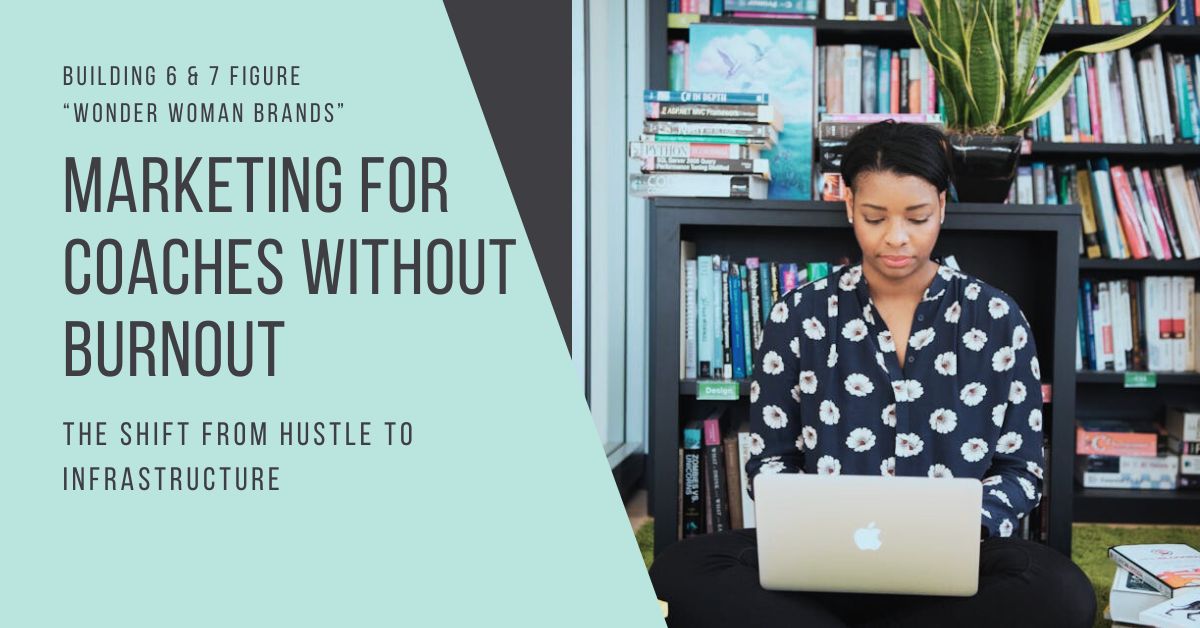

Marketing for Coaches and Service-Based Solopreneurs Has Changed
If you’re a coach, healer, holistic practitioner, or service-based solopreneur, you’ve probably felt it — that quiet but persistent sense that marketing has become a lot. Not just busy. Not just time-consuming. But mentally heavy in a way it didn’t used to be.
At some point, marketing stopped feeling like a support system for your work and started feeling like a second profession you never signed up for.
And if you’ve ever wondered why becoming visible online now seems to require the same level of focus, training, and consistency as becoming excellent at your actual craft — you’re not imagining it.
This isn’t a motivation problem.
And it’s definitely not a “you just need to try harder” problem.
It’s a structural one.

Marketing Has Quietly Changed — and Most People Didn’t Get the Memo
I’ve been working in online business and digital visibility since 2009, and one thing has become very clear over the years: the rules of marketing didn’t change overnight — they evolved quietly, then all at once.
Early on, building visibility online was relatively straightforward. You could:
-
Publish thoughtful content
-
Optimize a few pages for search
-
Show up consistently in one or two places
And over time, momentum would build.
Today, the landscape looks very different.
Marketing for coaches and practitioners now often includes:
-
Constant content production
-
Analytics
-
Paid traffic
-
Ever-changing algorithms
None of which are inherently bad — but together, they create a kind of cognitive overload that many service-based professionals weren’t prepared for.
Especially those whose real work happens in sessions, programs, retreats, or one-on-one conversations — not behind dashboards and posting calendars.

Why Hustle-Based Marketing Eventually Breaks Down
When marketing becomes overwhelming, the default advice is usually some version of:
“Just be more consistent.”
“You need to show up everywhere.”
“You just need the right system.”
But here’s the truth most people don’t say out loud:
Hustle scales pressure — not presence.
For coaches, healers, and holistic practitioners, hustle-based marketing often leads to:
-
Constant content creation with inconsistent results (the throw spaghetti at the wall and see what sticks” isn’t an intelligent strategy, it’s a “wing and a prayer” that can lead to disappointment and self-doubt.)
-
A feeling of always being behind (You can’t keep up and don’t know where to begine.)
-
Fragmented effort across too many platforms
-
Less energy for clients and actual service
It’s not that people aren’t capable of learning marketing.
It’s that becoming proficient at marketing now requires nearly the same investment of time, attention, and experimentation as becoming proficient at your profession.
And that’s where burnout and “online overwhelm” quietly enters the picture.
The Real Issue Isn’t Effort — It’s Infrastructure
Here’s the reframe most solopreneurs never hear:
Sustainable visibility is no longer built primarily on effort. It’s built on infrastructure.
Infrastructure, in this context, doesn’t mean complicated tech stacks or expensive software. It means something much simpler — and much more human:
-
Being visible in places where your audience already gathers
-
Operating inside trusted environments rather than shouting into open space
-
Sharing platforms instead of trying to build everything from scratch
-
Letting context and well-defined branding do some of the heavy lifting for you
When infrastructure is in place, marketing feels lighter. More supportive. More aligned.
When it isn’t, even the most consistent effort can feel exhausting.
This is the shift most people miss — especially coaches and practitioners who were taught that success comes from doing more, not from placing themselves more wisely.
A Smarter Definition of “Good Marketing”
Good marketing used to mean effort.
Today, good marketing means leverage.
It means understanding that visibility grows faster when you:
-
Let trust compound instead of restarting at zero
This doesn’t mean you stop creating content.
It doesn’t mean you stop showing up.
It means you stop trying to do everything alone.
And for many coaches, healers, and solopreneurs, that realization alone is where burnout begins to loosen its grip.
What Marketing Infrastructure Looks Like in Practice
(Without Turning You Into a Marketer)
When people hear the word infrastructure, they often imagine complexity — tech stacks, funnels, automations, or systems that require even more time and attention.
But in the context of sustainable visibility, infrastructure is actually much simpler.
It’s about placement.
It’s about choosing environments where:
-
Your audience already feels safe and curious
-
Trust already exists
-
The conversation is already happening
Instead of trying to manufacture attention from scratch.
For coaches, healers, and holistic practitioners, infrastructure often looks like:
-
Being present inside aligned platforms and communities
-
Sharing space with other professionals who serve similar audiences
-
Allowing visibility to be supported by context, not constant self-promotion
This is where “Buddha meets business strategy.”
Because the most effective marketing doesn’t feel forceful or frantic.
It feels aligned.
When Unconscious Misalignment Shows Up as Marketing Burnout
Here’s something I’ve observed again and again over the years:
Many purpose-driven business owners experience burnout not because they’re doing something wrong — but because they’re operating from unconscious misalignment. (Lack of attention on a business plan, business differentiation or a well-defined brand is an example of this
They’re trying to grow a business rooted in presence, healing, insight, or transformation…
using marketing models rooted in urgency, noise, and constant output.
That internal contradiction creates friction.
Burnout, in this sense, isn’t a failure of discipline.
It’s feedback.
It’s your system quietly saying:
“The way you’re trying to grow doesn’t match who you are or how you work best.”
Conscious alignment in marketing doesn’t mean doing less because you’re avoiding growth.
It means doing what actually supports growth without draining your nervous system.
Why Community-Based Visibility Outlasts Algorithms
Algorithms change.
Platforms rise and fall.
Best practices expire faster than most people can implement them.
Community, on the other hand, is remarkably stable.
When your visibility is anchored in:
-
Shared values
-
Shared interests
-
Shared purpose
…it becomes less volatile.
Community-based visibility doesn’t spike as dramatically — but it compounds more reliably.
It creates:
-
Repeated exposure without constant self-promotion
-
Borrowed trust without performative branding
-
Warm visibility instead of cold reach
For coaches and practitioners, this matters deeply — because your work relies on trust, resonance, and relationship far more than clever copy or clever hooks.
Who This Shift Matters Most For
This conversation is especially relevant if you are:
-
A coach who wants to focus on clients, not content calendars
-
A healer or practitioner whose work is relational and embodied
-
A solopreneur building something meaningful, not just profitable
-
Someone who knows their work has depth — but doesn’t want to shout online to prove it
If your business exists at the intersection of service and purpose, marketing will always feel wrong when it’s disconnected from support and community.
Infrastructure restores that missing support.
Redefining “Smart Marketing” for This Season
There was a time when “smart marketing” meant:
-
Doing more
-
Posting more
-
Optimizing more
Today, smart marketing looks different.
It looks like:
-
Choosing leverage over volume
-
Choosing placement over pressure
-
Choosing frameworks and systems over isolation
It’s less about mastering every channel and more about positioning yourself inside environments designed to carry momentum.
That’s not avoidance.
That’s wisdom.
Visibility Without Burnout Is Not a Shortcut — It’s a Maturity Curve
This is important to say clearly:
Moving from hustle to infrastructure is not about opting out of responsibility.
It’s about opting into a more evolved way of growing.
It’s what happens when:
-
Experience replaces experimentation
-
Alignment replaces urgency
-
Support replaces strain
Most businesses don’t fail because they lack effort.
They stall because they try to grow alone for too long.
A Gentle Invitation to Rethink How You Grow
If marketing has started to feel heavy…
If visibility feels harder than it should…
If you’re great at your work but tired of feeling behind online…
You’re not broken.
You’re not late.
And you’re not missing some secret tactic.
You may simply be ready for a different model — one where Buddha meets business strategy, and where conscious alignment replaces unconscious grind.
Visibility doesn’t have to cost you your energy to be effective.
And growth doesn’t have to feel like pressure to be real.
Sometimes, the most powerful shift isn’t doing more —
it’s choosing where and how you’re supported as you grow.
If this article speaks to you, meet A Conscious Marketing Visibility Framework for Practitioners Ready to Be Seen
This article is part of the Visibility Without Burnout series — an ongoing conversation about building sustainable, aligned visibility for coaches, healers, and solopreneurs who want their marketing to feel supportive, not depleting.
Discover more from The Athena Arena with Liz Gracia
Subscribe to get the latest posts sent to your email.

Leave a Reply