Quick Answer: AI search is changing how people find local businesses, but it isn’t replacing local SEO. It’s built on it. Google’s AI Overviews and AI Mode, ChatGPT, and similar tools pull from the same sources local SEO has always strengthened: your website, your Google Business Profile, your reviews, and what other trusted sites say about you. In a September 2026 study of more than 200,000 local AI searches, business websites made up 42% of everything those tools cited, and Google Business Profiles made up another 28.6%. AI local SEO isn’t a new discipline. It’s strong local SEO, organized so a machine can understand it, trust it, and repeat it.
What’s covered in this post:
- What’s changing: how AI search is reshaping local discovery
- Is local SEO dead? What the data actually says
- How AI Overviews and AI tools choose local businesses
- What I’ve seen with my own clients
- How to rank in AI Overviews and AI answers: 8 practical steps
- How to measure AI search visibility
- What’s next for local businesses in AI search
- FAQs
Every week, a business owner asks me some version of this: “Is AI going to make my Google ranking worthless?” It’s a fair question. The headlines are loud, the acronyms keep multiplying, and plenty of people are selling “AI optimization” as if it replaces everything you’ve already built.
My honest answer, after more than 25 years in SEO: the businesses showing up in AI answers are mostly the ones that already did local SEO well. AI adds a new layer to the results page. It doesn’t pull up the foundation. This post is the part of my local SEO playbook where local SEO meets AI search, and my goal is to give you a clear, practical picture without the hype.
What’s Changing: AI Search Is Reshaping How People Find Local Businesses
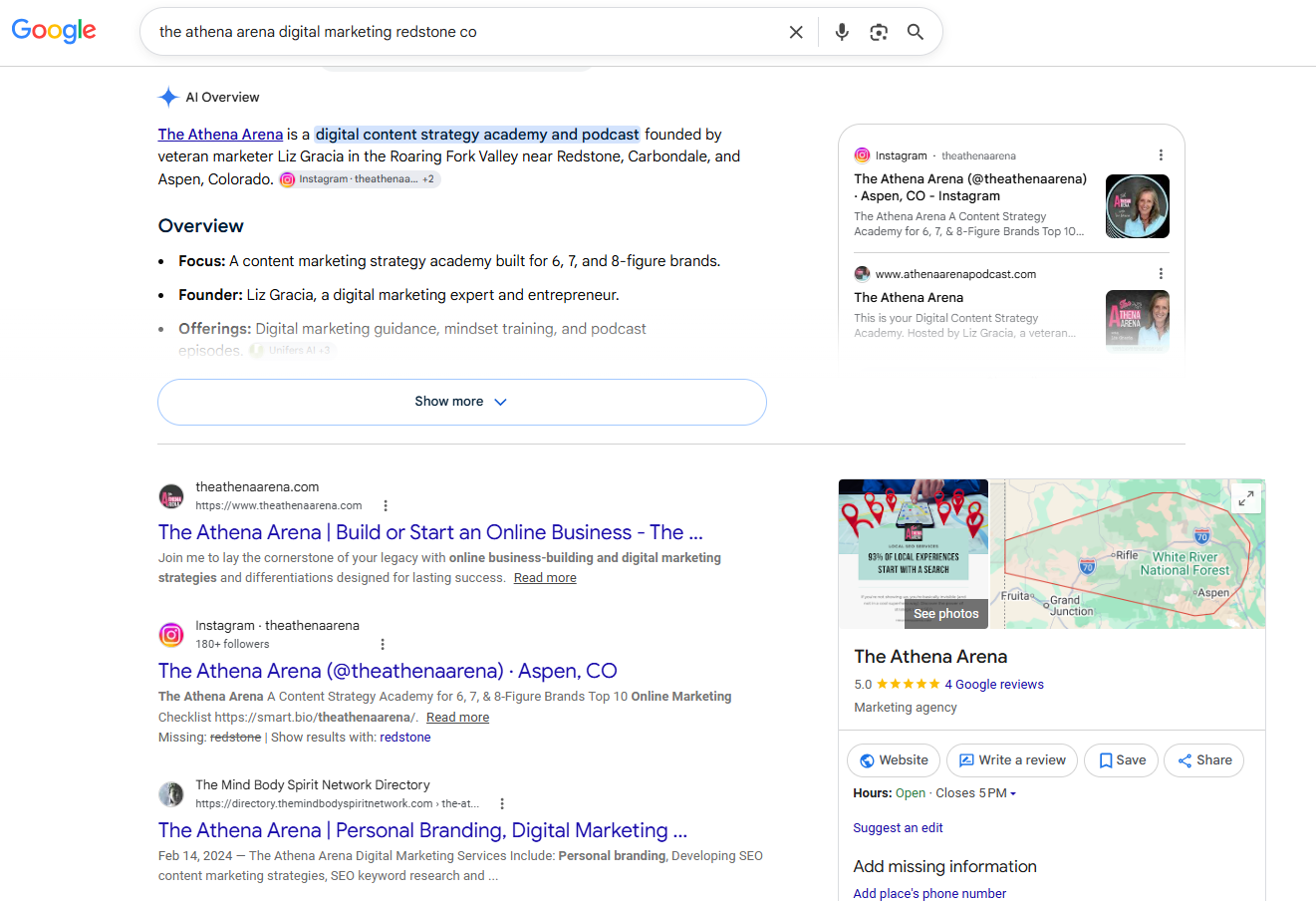
A few years ago, a local search meant typing “roofer Aspen” into Google, scanning the map, and clicking a few websites. Today, more people start with a full question: “Who’s the best roofer in Aspen for a metal roof that sheds snow without dumping it on the walkway?” And more of them ask an AI tool to answer it.
The shift is happening fast:
- Nearly half of consumers now ask AI for local recommendations. BrightLocal’s 2026 Local Consumer Review Survey found that 45% of consumers used ChatGPT or other AI tools for local business recommendations in the past year, up from 6% the year before. That makes AI the third most-used source for local recommendations, behind only Google and Facebook (BrightLocal).
- ChatGPT and Google’s AI Mode lead the way. In the same survey, 31% of consumers had used ChatGPT for business recommendations and 23% had used Google’s AI Mode (BrightLocal).
- Google’s AI tools are huge, and they’re getting more hands-on. Google says AI Mode has passed one billion monthly users (Google), and its help pages say AI Mode can research service costs, find appointment openings, fill out forms, and even call businesses (Google Search Help).
- AI summaries change who gets the click. Pew found people clicked a traditional search result in 8% of visits when an AI summary appeared, compared with 15% when there was none (Pew Research Center).
Here’s the mindset shift I want you to make. A Google ranking works like a line: someone is #1, someone is #7. An AI answer works more like a referral. Someone asks a trusted friend, “Who should I call?” and the friend names two or three people they feel sure about. Your job is no longer only to climb a list. It’s to be the business the machine feels confident recommending.
You’ve probably heard two terms for this work: answer engine optimization (AEO) and generative engine optimization (GEO). Both describe making your business easy for AI systems to find, understand, and cite. For a local business, they’re an extension of local SEO, not a replacement for it.

Is Local SEO Dead? What the Data Actually Says
No. If anything, local search has held up better against AI than almost any other kind of search.
Whitespark’s 2026 Local Search Ranking Factors report makes the same point: while informational websites have watched their traffic drop, people still do most of their local business discovery through Google’s local results, because those results serve local intent better than a chatbot does (Whitespark).
Consumer behavior backs that up:
- People check AI answers against Google. In BrightLocal’s 2026 consumer search behavior study, only 2% of people who started a local search with an AI tool used it as their only channel. 43% went on to check Google, and only 18% of AI users felt ready to contact a business based on the AI recommendation alone (BrightLocal).
- Google is still where most local searches happen. 71% of consumers used Google Search at some point during their most recent local business search, compared with 23% who used an AI tool (BrightLocal).
- Google itself says nothing special is required. “The best practices for SEO remain relevant for AI features in Google Search (such as AI Overviews and AI Mode). There are no additional requirements to appear in AI Overviews or AI Mode, nor other special optimizations necessary” (Google Search Central).
Put those numbers together and the real customer journey comes into focus: AI builds the shortlist, and Google closes the deal. A customer asks an AI tool for a few names, then goes to Google to check your profile, read your reviews, and look at your website before they pick up the phone. Your profile and your reviews are your closing argument. Local SEO is how you show up on both sides of that journey.
How AI Overviews and AI Tools Choose Local Businesses
AI tools don’t invent recommendations out of thin air. They read sources, compare them, and summarize what they find. BrightLocal’s September 2026 study, which analyzed 200,085 local searches across ChatGPT, Google AI Mode, and Google AI Overviews and nearly two million citations, gives us the clearest picture yet of where that information comes from (BrightLocal):
| Source | Share of all AI citations in local searches |
|---|---|
| Business websites | 42% (and 93% of all unique domains cited) |
| Google Business Profiles | 28.6% |
| Yelp | 9.5% |
| 2.2% | |
| Tripadvisor | 1.8% |
Your website and your Google Business Profile together accounted for about 70% of the citations. Those are the two assets local SEO has always been about. The tools are new. The raw material isn’t.
Structured, well-organized content
AI tools pull from pages that answer questions clearly and directly. Clear headings, a direct answer near the top of the page, short sections, and FAQs make it easier for an AI system to lift a passage and cite you. In Whitespark’s 2026 survey, local SEO experts ranked “dedicated page for each service” as the #2 factor for AI search visibility, and a scannable content structure across your whole site also ranked near the top (Whitespark).
This is why I treat AEO as a writing habit layered onto good content, not a separate strategy. If your service page opens with “We’re passionate about quality,” an AI tool has nothing to work with. If it opens with “We install snow retention systems on metal and shingle roofs in Aspen and Snowmass, usually in one to two days,” you’ve handed it a clear answer to repeat.
Trust signals AI tools weigh heavily
AI tools are cautious about who they recommend, so they look for corroboration. Think of it this way: your job is to make it easy for a machine to tell the truth about you. That means one consistent story, told the same way everywhere it appears.
- Reviews. High Google ratings ranked high among Whitespark’s AI visibility factors, along with the authority and variety of the sites where your reviews appear (Whitespark). Earning Google reviews steadily, plus reviews on the other sites your customers use, gives AI tools more evidence that real people trust you.
- Consistent business information. When your name, address, and phone number match everywhere, AI tools can be confident they’re describing the right business. BrightLocal recommends keeping your details consistent across all listings and mentions (BrightLocal). That’s why NAP consistency matters even more now than it did five years ago.
- Mentions on other trusted sites. Being included on expert-curated “best of” lists ranked near the top of Whitespark’s AI visibility factors, and 3 of the top 5 factors were citation or mention related. In AI search, mentions are the new links.
Distance still matters, but less for some tools
Here’s good news for businesses that serve clients beyond their own town. In BrightLocal’s study, 90% of the businesses Google’s AI Overviews recommended were within about 38 km (about 24 miles) of the searcher. For AI Mode, that radius stretched to about 64 km (40 miles), and for ChatGPT, about 287 km (178 miles) (BrightLocal).
In other words, some AI tools are far more willing than the Google map to recommend a business that isn’t right next door, as long as that business has clear, trustworthy content about the area it serves. That’s exactly what town-specific pages provide, and it’s the core of service area business SEO.
AI answers change from one search to the next
One more thing worth knowing: AI recommendations aren’t stable. When BrightLocal ran the same local prompt repeatedly, only 21% to 33% of the recommended businesses overlapped between runs, depending on the tool. Google Maps results were far more consistent (BrightLocal).
That’s why I don’t promise clients a “position” in ChatGPT or AI Overviews. With AI, the goal is inclusion, not position. You improve your odds of being named by being the clearest, best-corroborated option in your area.
What I’ve Seen With My Own Clients
The research matches what I’ve watched happen firsthand.
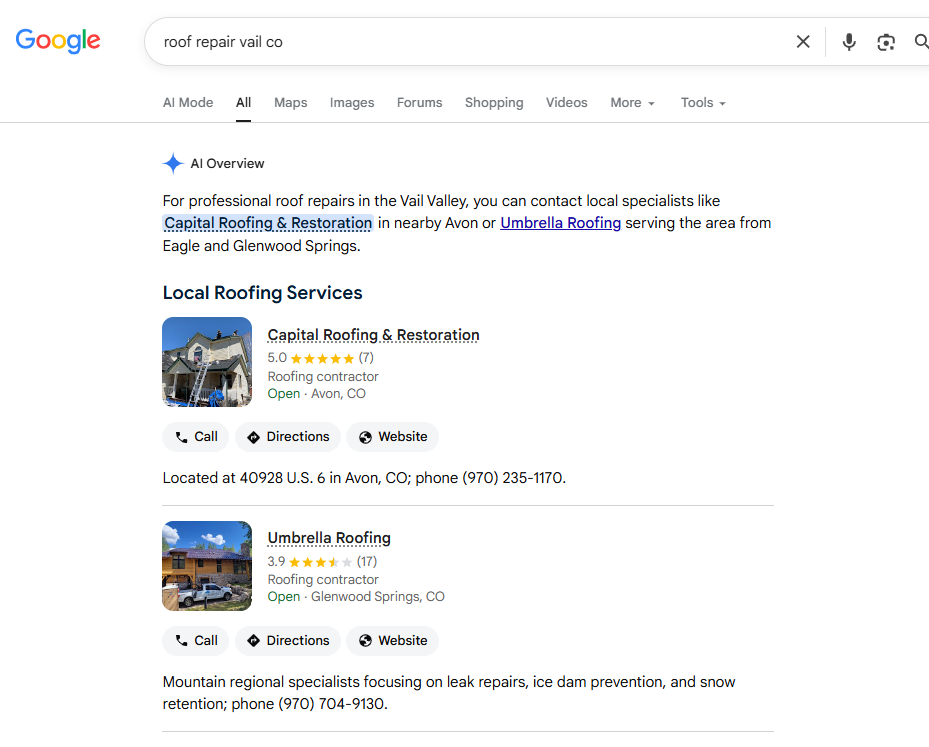
Umbrella Roofing is a Colorado roofer with offices in Glenwood Springs and Eagle. When I rebuilt their website with close to two dozen keyword-driven pages, I wrote each problem-focused page to answer the question first and explain the service second. Within weeks of Google reindexing the site, Umbrella was appearing inside Google’s AI Overviews for problem searches like “snow retention roof Aspen” and “ice dam prevention Beaver Creek.” For one of those searches, Google pulled Umbrella’s explanation of self-regulating heat cables directly into the expanded overview.
We didn’t do anything special for AI. We wrote clear, specific answers to the problems mountain property owners actually search for. The full story is in the Umbrella Roofing case study.
Psychic Medium Cheryl Murphy taught me the other half of the lesson. While we were actively publishing content for her, she appeared in Google’s AI Overviews and in the image panel beside them. Almost a year after our work ended, her map pack and page 1 organic rankings were still holding, but her AI Overview visibility had faded (Cheryl Murphy case study).
That contrast is worth sitting with. Organic rankings behave like a well-built house: they stand for years. AI visibility behaves more like a conversation: it favors whoever is still talking.
How to Rank in AI Overviews and AI Answers: 8 Practical Steps
There’s no switch you can flip to guarantee an AI citation. But if you want to know how to optimize for AI Overviews as a local business, these are the steps that hold up in the research and in my own client work.
1. Keep your Google Business Profile complete and current
Your profile was the second-largest source of local AI citations in BrightLocal’s study, and Google’s own AI guidance recommends keeping your Business Profile information up to date (Google Search Central). If you’re not sure what a GBP is or what belongs in it, start there. Check your categories, hours, services, description, photos, and service areas at least once a quarter.
2. Give every service its own page
One “Services” page listing everything is hard for anyone, human or AI, to use. A dedicated page for each core service gives AI tools a clear source to cite when someone asks about that exact service.
3. Create clear pages for the towns you serve
BrightLocal recommends obvious location pages with good information for each place you serve (BrightLocal). Each page should be genuinely unique to that town, with local conditions, neighborhoods, and proof from clients there.
4. Answer questions directly, near the top of the page
Open each page with a short, plain-language answer: what you do, where, for whom, and roughly what to expect. Then add an FAQ section built from the questions customers actually ask you on the phone. This is the heart of AEO, and it’s simply good writing.
5. Keep your NAP consistent everywhere
Match your business name, address (if you show one), and phone number exactly across your website, your Google Business Profile, Yelp, Facebook, and every directory you’re listed on. Inconsistent details make it harder for AI tools to confirm they’ve found the right business.
6. Earn reviews on more than one site
Google reviews matter most, but AI tools also cite Yelp, Facebook, and industry-specific review sites. Ask happy clients to review you where your customers are most likely to look, and respond to the reviews you get.
7. Get mentioned by trusted local and industry sites
Look for opportunities to be featured on “best of” lists, in local news, in chamber of commerce and association directories, on partner websites, and on podcasts in your field. Every credible mention gives AI tools another source confirming who you are and what you do.
8. Keep your site active
Cheryl’s experience is the reminder here: AI visibility fades when a site goes quiet. Add new content, update service pages, and refresh your profile regularly. You don’t have to publish every week, but you do need to show steady signs of life.
How to Measure AI Search Visibility
Because AI answers change from one search to the next, measuring AI search visibility takes a different approach than checking your Google ranking.
- Ask the tools yourself, more than once. Try the questions your customers would ask in ChatGPT, Google AI Mode, and Perplexity, using your town name. Repeat each prompt a few times on different days, and note whether you’re mentioned and which sources are cited.
- Watch the sources, not just the answer. If a competitor keeps appearing, look at which sites the AI tool cites for them. Those are often the directories, lists, and publications worth pursuing.
- Add “ChatGPT or another AI tool” to your “How did you hear about us?” options. AI answers often shape a decision without sending a click, so your intake form and your phone conversations are some of the best measurement tools you have. Watch for growth in people searching for your business by name, too.
- Keep tracking Google Maps and organic rankings. BrightLocal found that Maps visibility doesn’t guarantee AI visibility, so track both (BrightLocal).
What’s Next for Local Businesses in AI Search
AI search is moving quickly, and I’ll keep updating this post as the research catches up. Here’s where I see it heading:
- More action inside the answer. As AI Mode books appointments and calls businesses, accurate hours, services, and pricing on your profile and website will matter even more. If the AI gets your hours wrong, it may send a customer to your competitor without you ever knowing.
- More weight on outside mentions. As AI tools lean on what others say about you, local press, curated lists, and reviews across multiple sites will keep growing in importance.
- The fundamentals keep winning. Every major study I’ve read points the same way: relevant, clear, well-organized, trustworthy content on a site Google can crawl.
If you want the bigger picture of AEO and generative engine optimization beyond local search, including what the research does and doesn’t prove, read my post with AEO and GEO explained.
Frequently Asked Questions
What’s the difference between local SEO and AEO/GEO?
Local SEO helps your business show up in Google’s map pack and local organic results. AEO (answer engine optimization) makes your content easy for AI tools to lift as a direct answer. GEO (generative engine optimization) makes your business easy for AI tools to find, trust, and cite. For a local business, AEO and GEO are built on top of local SEO, using the same website, profile, reviews, and citations.
Do I need to do anything differently for AI Overviews specifically?
Not much. Google says there are no additional requirements or special optimizations needed to appear in AI Overviews or AI Mode, and that normal SEO best practices still apply. The biggest change I recommend is formatting: answer questions directly near the top of each page, use clear headings, and add FAQs.
Is generative engine optimization worth investing in yet?
Yes, as part of a solid local SEO strategy, not as a separate project. The most reliable GEO work for a local business is the same work that improves local SEO: clear service and location pages, a complete Google Business Profile, consistent listings, steady reviews, and mentions on trusted sites. Be cautious of anyone selling GEO “hacks” or guaranteed AI placements.
Is local SEO dead because of AI?
No. Whitespark’s 2026 report found local search has held up far better than informational search, and BrightLocal found that 43% of people who start a local search with AI go on to check Google. AI tools also draw heavily on business websites and Google Business Profiles, which is exactly what local SEO builds.
How do I get my business recommended by ChatGPT?
You can’t buy or request a ChatGPT recommendation, but you can make your business easier to recommend. Build clear service and location pages, keep your business information consistent across directories, earn reviews on Google and other sites, and get mentioned on trusted local and industry websites. In Whitespark’s survey, inclusion on curated “best of” lists ranked near the top of the AI visibility factors.
Why does AI recommend different businesses every time I ask?
AI answers are generated fresh each time, so the list changes. In BrightLocal’s study, only 21% to 33% of recommended businesses overlapped when the same local question was repeated. The goal isn’t to “rank #1” in ChatGPT. It’s to be included as often as possible by being the clearest, best-supported option.
Does schema markup help me show up in AI Overviews?
Schema can help search engines understand your business details, and it’s worth having, but it’s not a shortcut to AI citations. Google says structured data doesn’t guarantee a special result, and an Ahrefs experiment that added schema to 1,885 pages found no major lift in AI citations (Ahrefs). Clear, helpful content matters far more.
Ready to Show Up in AI Answers and on the Map?
If you’re wondering whether your business comes up when customers ask an AI tool for a recommendation, or why a competitor keeps getting named instead of you, let’s look at it together.
Book a free 30-minute consultation and I’ll walk through how your business appears in Google, Google’s AI Overviews, and ChatGPT for the searches that matter most, and what I’d fix first. You can also learn more about my local SEO services.
Prefer to start with data? Get a free map visibility audit at theathenaarena.com/localseo, and I’ll review the results with you personally.
I’m Liz Gracia. I’ve been doing SEO since 1999, and I’ve lived in Colorado’s Roaring Fork Valley since 2004. I work with local businesses here in the mountains and across the country.
Discover more from The Athena Arena
Subscribe to get the latest posts sent to your email.
