Picture a homeowner in Aspen with water dripping through her ceiling. She grabs her phone, searches “roof repair near me,” and Google shows a map with three businesses on it. She taps the first one with good reviews and calls. She never scrolls down to see anyone else.
That moment plays out thousands of times a day, in every industry and every Colorado town. Most business owners have no idea why a competitor lands in one of those three spots and they don’t.
There’s a second problem few people see coming: what if you can’t win those three spots at all? Your best clients may live in a town where you don’t have an address, or your category may be too crowded to crack the map this year. Then what?
I’m Liz Gracia, and I provide local SEO services for small businesses in Colorado and beyond. This is the playbook I use with clients to answer both questions.
Quick Answer: Local SEO gets a business found in two places on Google: the 3-pack (the map with three businesses) and the organic results right below it. The map pack is decided mostly by distance, your Google Business Profile, and your reviews, so it only reaches the towns near your address. Organic pages built for each service and each town reach everywhere else. The businesses that win show up in both, and more and more often inside Google’s AI answers too.
What’s covered:
- What the Google 3-pack is, and why it still matters as AI takes over search
- Two real client results: a Colorado mountain roofer and a Los Angeles psychic medium
- How to rank on page 1 when the map pack isn’t an option
- The five-part local SEO framework I use with every client
- How this plays out in Boulder, the Roaring Fork Valley, and the Vail Valley
- What AI search means for local businesses

What Is the Google 3-Pack (and Why Does It Beat Page One)?
The Google 3-pack is the box of three business listings with a map that appears for local searches like “plumber near me” or “massage therapist Boulder.” People also call it the Google map pack or the local 3-pack. They’re the same thing. My guide to what the Google 3-pack is goes deeper on how Google fills those three spots.
Those spots matter because of where the clicks go:
- It shows up for nearly every local search. In Whitespark’s 2026 study of local business queries, the local pack appeared on 93% of searches with clear local intent (Digital Applied).
- It earns more clicks than anything else on a local results page. In Moz’s well-known local search study, 44% of searchers clicked a 3-pack result, compared with 29% for organic results and 19% for paid ads (Red Local Agency).
- Every spot in the pack pays. First Page Sage’s September 2026 report puts click-through rates at 14.8% for local pack position #1, 12.6% for #2, and 11.9% for #3 (First Page Sage).
- It drives real actions. SOCi’s analysis of more than 300,000 Google listings found that businesses in the 3-pack earn 126% more traffic and 93% more actions, like calls, website clicks, and direction requests, than businesses ranked 4 to 10 (SOCi).
One more number shows where this is heading. In that same First Page Sage report, the click-through rate for the #1 organic result fell 82% in a single year as AI answers took over the page, while local pack #1 fell only 16%. An AI answer can explain your service, but it can’t drive a customer to your door. The map pack has become the most resilient real estate on Google.
Look at the Moz numbers again, though. Organic results still earn almost a third of the clicks. The strongest local businesses show up in both places, and that’s what this playbook is built to do.
Real Results: Two Different Wins, Two Different Strategies
I lead with results because that’s what you should judge any local SEO company on. Here are two very different clients in two very different markets.
Umbrella Roofing: #1 on Google from offices miles from its best clients
Umbrella Roofing has offices in Glenwood Springs and Eagle, Colorado. Its highest-value clients are in Aspen, Snowmass, Vail, and Beaver Creek, where Google’s map pack favors roofers located closer in.
I rebuilt the website with close to two dozen landing pages built around real searches: each service, each type of client, and each mountain community. Four weeks into the project, and just days after Google reindexed the site, Umbrella was ranking #1 organically for searches like “roof repair Aspen,” “roof replacement Vail,” and “roof repair Vail.” It also started showing up inside Google’s AI Overviews for problem-based searches like snow retention and ice dam prevention. For “ice dam prevention Beaver Creek,” Umbrella appeared in six different places on the same results page.
Check out my Case Study for Local SEO for Roofers and Umbrella Roofing here.
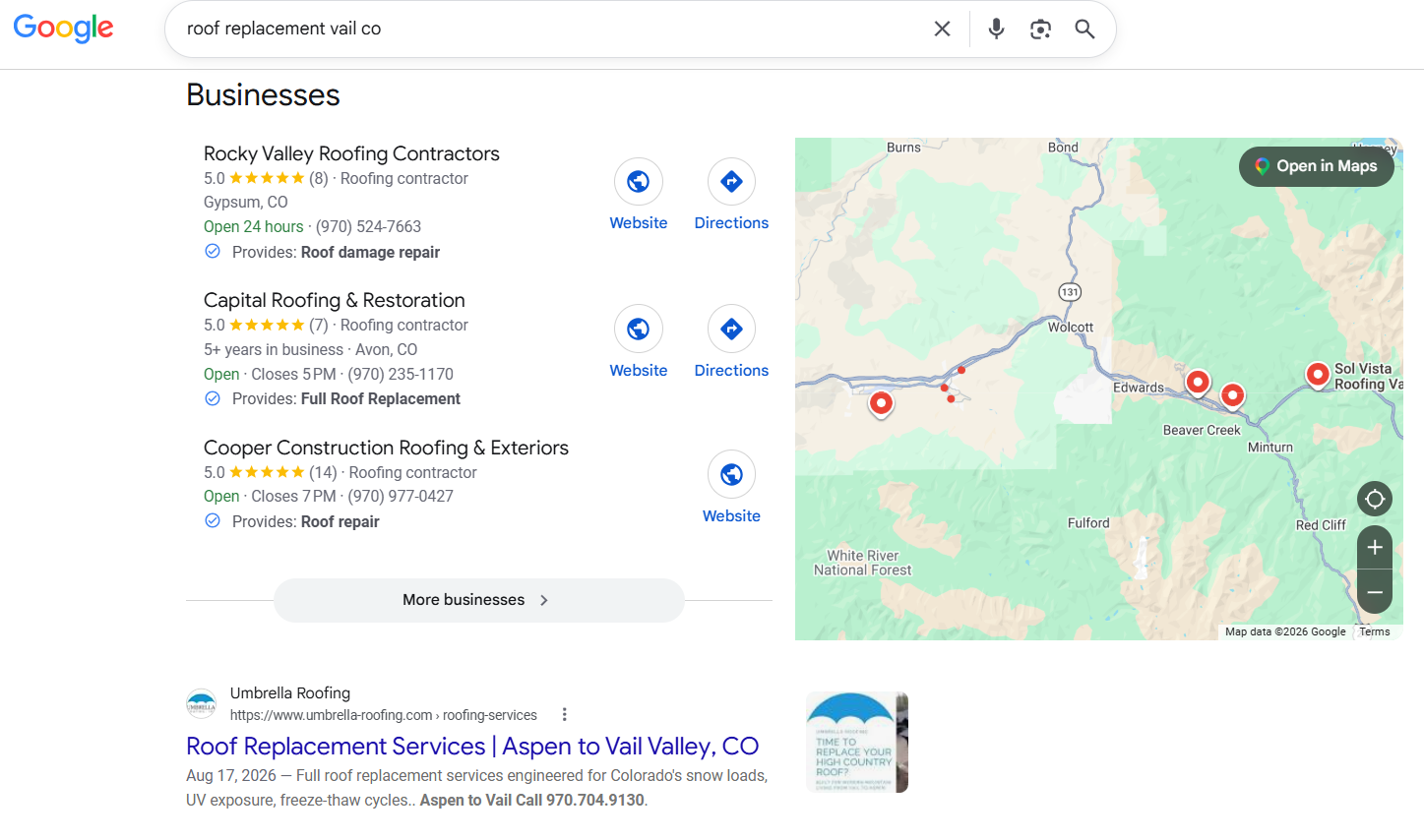
They did all of that without being in the map pack. Their Google Business Profiles were only recently claimed, and map rankings take months to build. That’s the next phase. You can see every search, the screenshots, and the honest gaps in how Umbrella Roofing ranks #1 without the map pack.
Cheryl Murphy: page 1 across Los Angeles from a Palmdale address
The second win is in one of the most crowded niches in California. Cheryl Murphy is an evidential psychic medium whose Google Business Profile is in Palmdale, about an hour’s drive from the Los Angeles neighborhoods where many of her ideal clients live.
We optimized her profile for the map pack close to home and built city-specific pages and blog content for the higher-income communities she wanted to reach. When I re-ran her searches in September 2026, almost a year after our last round of work and with no paid ads, she was:
- #1 organic and #2 in the map pack for “evidential medium los angeles”
- #3 in the map pack, plus #1 and #2 organic for “evidential medium beverly hills”
- #1 organic for “evidential medium santa monica”
- #3 organic for “psychic medium encino”
Check out my case study for Cheryl Murphy, local SEO for service-based professionals here.
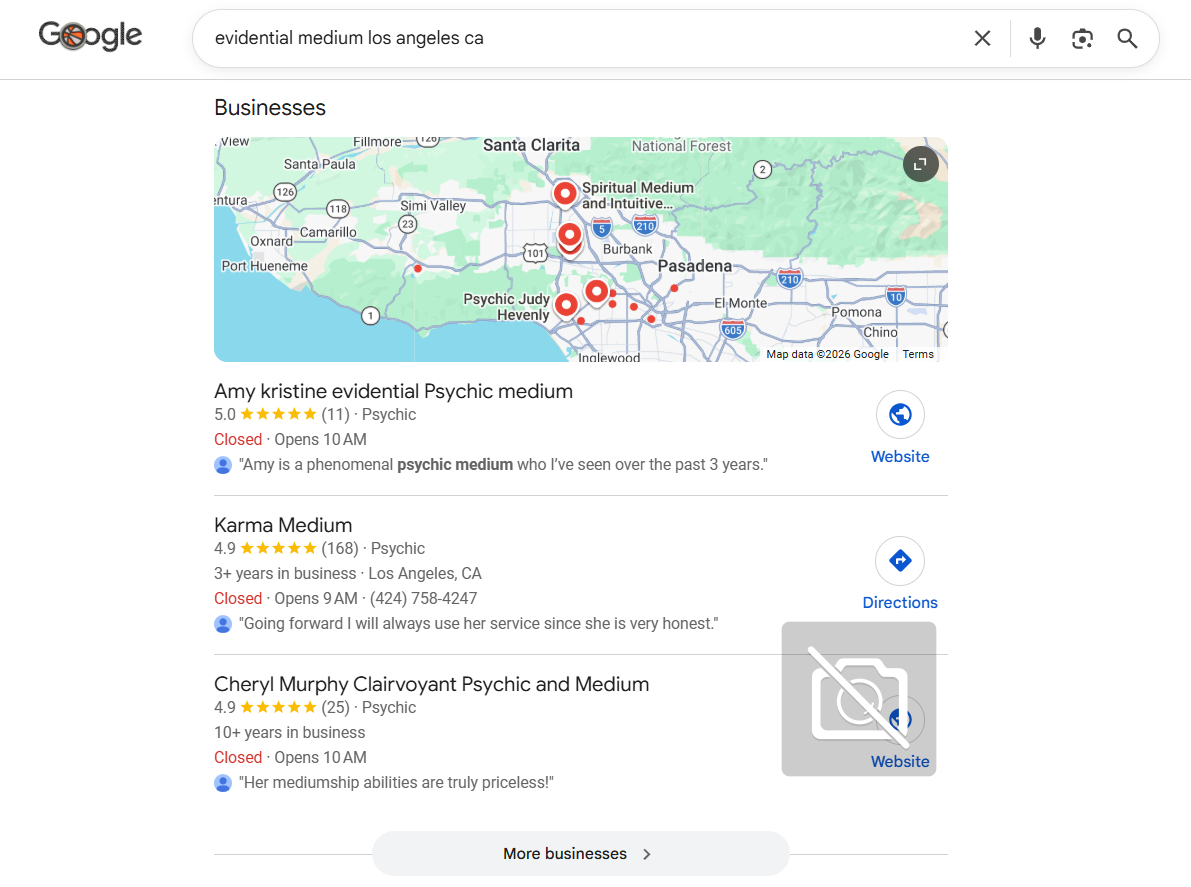
Not every search won. She doesn’t show up for “psychic medium beverly hills,” and I say so in the write-up. Her Los Angeles and Beverly Hills map spots are also the exception, not the rule: a sharp niche keyword earned them, and I wouldn’t build a plan around repeating that. You can read the full story in the Cheryl Murphy case study.
Why both strategies work
Two forces explain these results.
First, distance matters more than almost anything else in the map pack. A Search Atlas machine-learning study of 7,718 businesses found that proximity to the searcher accounted for 55.2% of its model’s predictive power for local rankings, with review count next at 19.2% (Search Atlas). You can’t move your office closer to every customer.
Second, most of the rest is within your control. In Whitespark’s 2026 Local Search Ranking Factors survey of 47 local search experts, Google Business Profile signals carried the most weight for the map pack, at 32%, and review signals grew from 16% to 20% of the weight since 2023 (theStacc). Reviews also shape who gets the click: in a BrightLocal consumer panel test, local pack listings with a 5-star rating earned 28% more clicks than listings with no rating (BrightLocal).
So the playbook has two halves: win the map pack where you can, and rank organically where you can’t. Your map listing has a radius. Your website has reach.
When You Can’t Win the Map Pack, How Do You Rank?
Because proximity carries so much weight, a single Google Business Profile can realistically compete for the map pack only in the towns around its address. Optimization can’t fully overcome that. If your best clients live 30 or 60 miles away, the profile alone has a ceiling.
The answer is dedicated organic content, mostly service-area pages and local blog posts, that ranks in positions 1 to 3 on page 1, right below the map pack, for the exact towns and neighborhoods your profile can’t reach. Whitespark’s 2026 survey backs this up: the #1 local organic ranking factor is a dedicated page for each service, and #2 is content relevant to the city or neighborhood being searched (Whitespark).
This takes a different skill set from map pack optimization, and it’s where many of my clients in competitive niches see their real growth. It’s how Umbrella ranks in Aspen from Glenwood Springs, and how Cheryl ranks in Santa Monica from Palmdale. You can’t move your office. You can move your content.
If this sounds like your situation, my guide to service area business SEO shows you how to rank on page 1 without the map pack.
What Is the Local SEO Framework I Use With Every Client?
Every client is different, but the framework stays the same. It has five parts.
1. Google Business Profile optimization
Your profile is the foundation of your map pack visibility. If you’re just getting started, begin with what a Google Business Profile is and why it matters. Most businesses claim a profile and leave it half-finished: the wrong primary category, missing services, few photos, and outdated hours. Whitespark’s 2026 survey ranks the primary category as the #1 map pack factor, and being open at the time of search now sits at #5 (Whitespark). My step-by-step guide shows you how to optimize your Google Business Profile to compete for the 3-pack.
2. Local keyword research
You can’t rank for searches you don’t know about. Good local keyword research finds the exact “near me” and service-plus-town phrases your customers type, like “ice dam removal Snowmass” or “evidential medium Santa Monica.” Those phrases become your pages, your profile services, and your content plan.
3. Reviews and reputation
Reviews are both a ranking factor and a click factor. They help Google decide where you rank, and they help customers decide whether to call. The goal is a simple, steady system for asking every happy customer, so reviews arrive month after month instead of in bursts. Recency counts too: recent reviews rank #11 among Whitespark’s 2026 map pack factors. Learn how to get more 5-star Google reviews the right way.
4. NAP consistency and local citations
NAP stands for your business name, address, and phone number. When those details don’t match across Google, Yelp, Facebook, directories, and your own website, Google gets less confident about which information is right. It’s the unglamorous part of local SEO, but it can quietly cap how high your profile ranks, and listings carry even more weight in AI search (more on that below). My guide to NAP consistency and local citations walks through the cleanup.
5. On-page and content signals
Your website either reinforces your local relevance or undercuts it. This is where you build a dedicated page for each service, a page for each important town, contact details that match your profile, and helpful content that answers the questions your customers actually ask. It’s also the part that powered both case studies above.
Who Is This For? Any Colorado Small Business
This isn’t a roofing playbook or a wellness playbook. My two case studies are a mountain roofer and a Los Angeles psychic medium, about as different as two businesses get, and the same framework drove both.
It fits:
- Contractors and home services: roofers, builders, remodelers, landscapers, plumbers, electricians
- Professional services: attorneys, accountants, financial advisors, real estate agents
- Design and creative firms: architects, interior designers, photographers
- Wellness practitioners: massage therapists, acupuncturists, coaches, energy healers, mediums
- Multi-town and service-area businesses: anyone whose best clients live somewhere other than where the office is
If you’re comparing local SEO services for small business, or deciding whether to hire a local SEO company or agency, ask to see real searches, real rankings, and an honest account of what didn’t work. That’s the standard I hold myself to.
Why Do I Lead With Local SEO Over Paid Ads?
I’m not against ads. They’re useful for a launch, a seasonal promotion, or testing a new service. But for most established local businesses, organic visibility is the better long-term investment.
Ads rent visibility. SEO builds it. The day you stop paying for ads, the calls stop too. A page that ranks keeps bringing in leads, and every new page adds strength to the ones you already have. Cheryl Murphy’s rankings held for almost a year after our work ended, and her organic traffic kept growing. In the Moz study above, local searchers also clicked map pack and organic results far more often than ads.
If you’re weighing your budget right now, my comparison of local SEO vs. Google Ads lays out the 2026 costs side by side.
How Does Local SEO Work Across Colorado: Boulder, the Roaring Fork Valley and the Vail Valley?
Local SEO in Colorado looks different depending on where you are. I’ve lived in the Roaring Fork Valley since 2004, and these are three very different markets:
- Boulder: A dense, competitive market where many well-marketed businesses sit within a few miles of each other. Semrush rates “boulder seo” at a keyword difficulty of 42, higher than “seo denver” at 35 (US database, October 2026). My guide to local SEO in Boulder covers what it takes to stand out.
- The Roaring Fork Valley: About 40 miles from Aspen to Glenwood Springs, with tight-knit towns and very different customers in each one. A Google Business Profile in Carbondale won’t compete for the Aspen or Basalt map pack. This is how I approach local SEO in the Roaring Fork Valley.
- The Vail Valley: A resort economy where many clients are second homeowners searching from out of state, and where many businesses are based downvalley in Eagle, Edwards, or Gypsum. This is how local SEO in the Vail Valley works when you don’t have a Vail address.
In mountain corridor markets, one profile can’t win the map pack in every town. It’s the same beyond-the-radius playbook I used for Cheryl Murphy in Los Angeles, with ski lifts instead of freeways.
What’s Next: How Does Local SEO Meet AI Search?
Google’s AI Overviews, AI Mode, and tools like ChatGPT now answer “best [service] near me” questions directly. That changes how people find local businesses, but it doesn’t replace local SEO. It builds on it.
A few things are already clear:
- AI answers take clicks from regular results. First Page Sage’s September 2026 data shows the #1 organic result earns about 22.6% of clicks when no AI answer is on the page, but only 3.6% when one appears. The first source cited inside the AI answer earns 5.2% (First Page Sage).
- Your website matters even more. In Whitespark’s 2026 survey, on-page signals carried the most weight for AI search visibility, at 24%, while Google Business Profile signals fell to 12% (Digital Applied).
- Distance barely matters inside AI answers. Local Falcon’s 2026 research found effectively no correlation between a business’s distance and its position within Google’s AI Overviews (Digital Applied).
That last point is good news for service-area businesses. Inside an AI answer, the closest business doesn’t win. The best-documented one does: clear, specific pages, consistent listings, and real reviews. Strong pages can earn a spot in AI answers even in towns where you’ll never win the map pack, which is exactly what happened with Umbrella Roofing’s ice dam and snow retention pages.
My guide to what AI search means for local SEO goes deeper on the local side, and AEO and GEO explained covers the bigger picture in plain language.
Frequently Asked Questions
How long does local SEO take to work in Colorado?
New or improved website pages can start showing up within days or weeks once Google indexes them. For Umbrella Roofing, new pages appeared within about three days of resubmitting the site, with #1 organic rankings within that same time frame. Map pack rankings usually take three to six months, and longer in competitive markets like Boulder or Denver.
How much do local SEO services cost?
Cost follows scope: how many pages your website needs, how much work your profile needs, and how crowded your market is. A business in a mountain town often needs far less than one in a busy Front Range category. A free consultation or audit gives you a realistic picture before you commit to anything.
Is local SEO worth it for a small business?
For most established local businesses, yes, especially when one new client is worth hundreds or thousands of dollars. Organic rankings keep working after the work is done, while ads stop the day you stop paying. My comparison of local SEO vs. Google Ads walks through the real 2026 costs.
Do I need a Google Business Profile if I already have a website?
Yes. Your website and your profile do different jobs. Your profile gets you into the map pack, which earns the biggest share of local clicks. Your website gets you into organic results and AI answers, and it reinforces your profile’s relevance. The strongest local businesses use both.
Can I rank in local search results outside my Google Business Profile’s map pack radius?
Yes, through organic content built for those specific towns and neighborhoods. Umbrella Roofing ranks #1 in Aspen and Vail from offices in Glenwood Springs and Eagle, and Cheryl Murphy ranks on page 1 in Santa Monica and Beverly Hills from Palmdale. My guide to service area business SEO shows you how to rank on page 1 without the map pack.
Ready to Get Into the 3-Pack, and Beyond It?
If you want to know where your business stands, and which path fits you (the map pack, organic pages, or both), I’d love to help.
Try this first: search your top service plus the town where your best clients live. Note who’s in the map pack and who’s #1 in the organic results below it. If you’re in neither, that gap is your plan.
Book a free 30-minute consultation
On Zoom, we’ll look at where you show up now, who’s outranking you and why, and what it would take to reach the clients you want.
Not ready for a conversation yet? Start with a free Map Pack visibility audit at theathenaarena.com/localseo. I’ll show you where you rank on the map and personally review the results with you.
I’m Liz Gracia, a local SEO consultant who has lived in Colorado’s Roaring Fork Valley since 2004. I help local businesses across Colorado and the country get found by the clients they want.
Discover more from The Athena Arena
Subscribe to get the latest posts sent to your email.
