
If you build custom homes in Colorado’s mountain towns, your shop is probably not where your best projects are. Most builders I know work out of Glenwood Springs, Carbondale, Eagle, or Gypsum because that’s where commercial rent makes sense. The homes they build are in Aspen, Snowmass, Vail, Beaver Creek, and Cordillera.
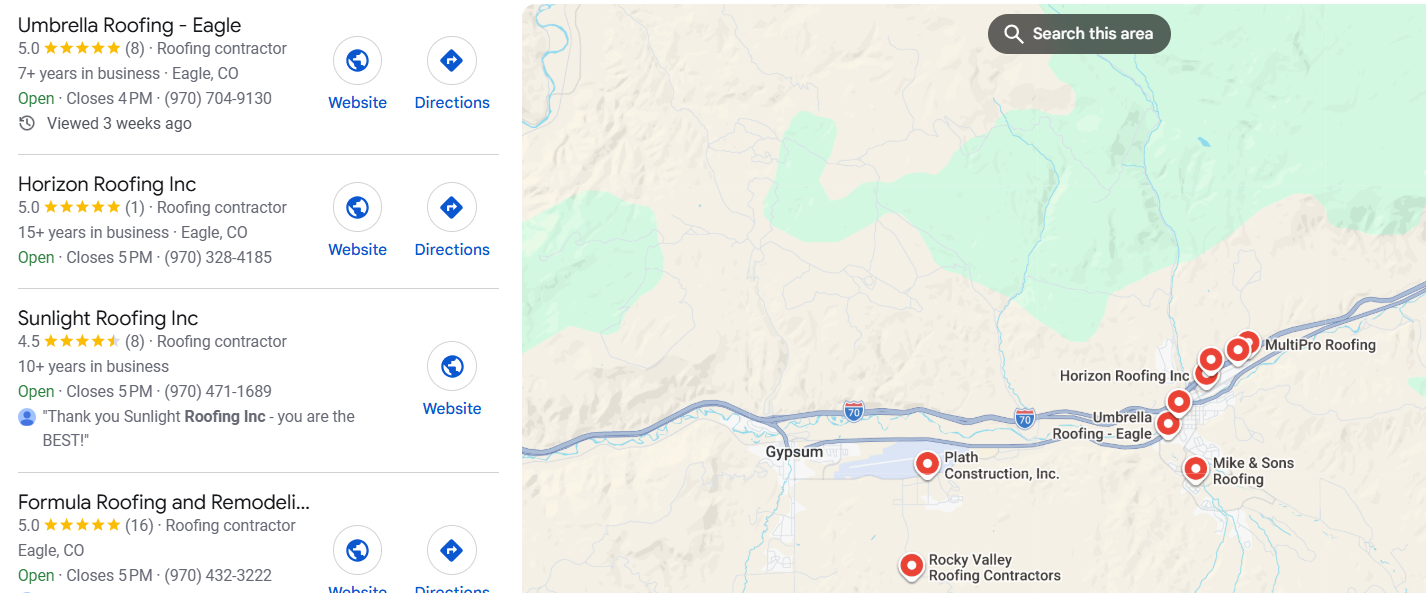
That gap matters more than most builders realize. Google’s map results lean heavily on how close a business is to the town being searched. And while you’re busy building, builders from Denver, and even from out of state, are publishing pages aimed at the exact neighborhoods you work in. I recently found an out-of-state luxury builder with a page written specifically about building on Aspen’s Red Mountain Road.
This is where home builder SEO comes in. I want to show you how it works with a real client whose problem was exactly yours.
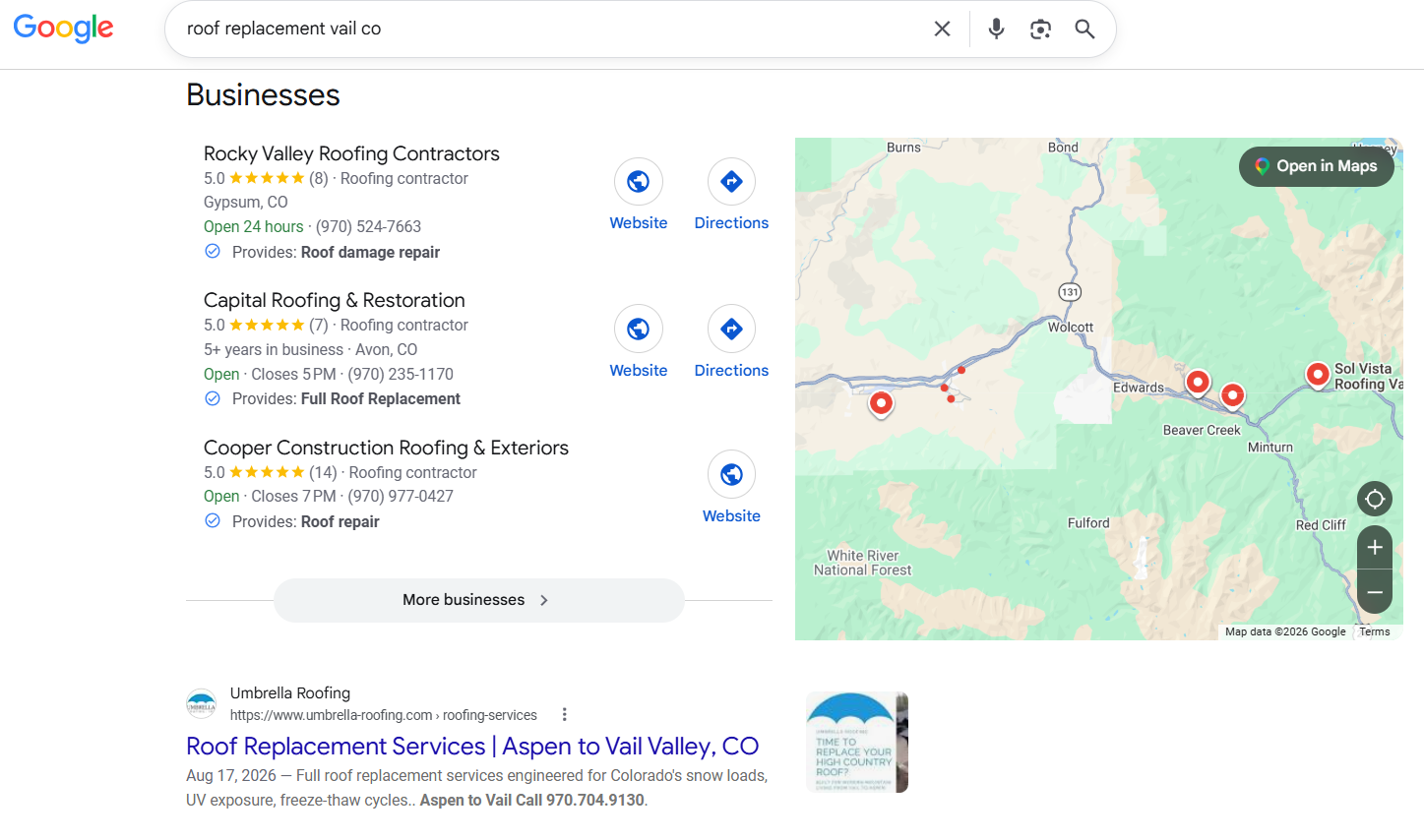
A Real Example: The Contractor Who Ranks Where He Doesn’t Have an Office
Umbrella Roofing is a mountain roofing company with offices in Glenwood Springs and Eagle. Like most builders, their best clients are an hour or more up the road in Aspen, Snowmass, Vail, and Beaver Creek. And like a lot of builders, their website had been sitting untouched for years. Only the homepage ranked, and Google had all but stopped indexing it.
I rebuilt their site with close to two dozen new pages, each aimed at a specific search: every core service, every major community they serve, and every type of partner they want to work with, including builders, architects, HOAs, and property managers.
Within about three days of resubmitting the site to Google, the new pages started showing up. A few weeks later, here’s what I saw in live searches:
| Search | Result |
|---|---|
| roof repair Aspen | #1 organic |
| roof replacement Vail | #1 organic |
| roof replacement Aspen | #1 organic |
| snow retention roof Aspen | Google AI Overview, image listings, and #1 organic |
| ice dam prevention Beaver Creek | Six separate spots on page one |
SEMrush’s independent ranking data also shows them at #1 for “roof replacement Vail.” None of this came from the Google map pack. Their profiles were only just claimed, and map rankings take months. It came from the website. You can read the full Umbrella Roofing case study for every detail.
A roofer and a custom home builder have different businesses, but the search problem is the same: you need to be found in towns where you don’t have an address.
Why SEO Matters More for Builders Than Almost Anyone
Search volume for builders in small mountain towns is modest. SEMrush shows only a few dozen searches a month for “custom home builders Vail” or “custom home builders Aspen.” But think about what each of those searches is worth. A single custom home here can run well into seven figures. One project can carry your schedule for a year or more.
And the people searching aren’t only homeowners:
- Second-home buyers often research builders from Texas, California, or New York before they ever visit.
- Architects and designers check out builders before recommending them to a client.
- Referrals look you up too. When a past client recommends you, the first thing the new prospect does is search your name and your town. What they find either confirms the referral or raises questions.
Someone is already paying more than $20 a click for “custom home builders Vail” on Google Ads. Ranking organically means you get that visibility without paying for every click.
The Home Builder SEO Plan I’d Use for You
Here’s how I translate what worked for Umbrella into a plan for a custom home builder.
1. Build a page for every town and neighborhood you build in
A footer line that says “Serving Aspen, Snowmass, Basalt, and Vail” isn’t enough. Each community deserves its own page that shows you know it: the neighborhoods, the lot challenges, the design review process, the projects you’ve completed there, and what building there actually costs.
This is the core strategy behind ranking in towns where you don’t have an office. If you want the deeper explanation, here’s how to rank on page 1 without the map pack.
2. Create pages for the types of projects you want more of
Think about how a buyer describes what they want: “mountain modern custom home,” “timber frame home builder,” “ski-in ski-out home construction,” “luxury remodel,” “home addition.” Each of those deserves its own page, with your projects, process, and answers to common questions.
Umbrella’s site has separate pages for roof replacement, roof repair, snow retention, and ice dam prevention. That’s why it ranks for each one instead of hoping the homepage covers everything.
3. Speak directly to your referral partners
This was the biggest insight from the Umbrella project. When I sat down with the owners, I learned their most valuable work comes from partners who send repeat projects, not one-time homeowners. So we built dedicated pages for builders, architects and designers, HOAs, and property managers.
For a home builder, your partners are architects, interior designers, owner’s representatives, real estate agents, and land brokers. A page written for architects that explains how you collaborate, how you handle budgeting during design, and which firms you’ve worked with gives them something to share and gives Google another reason to show you.
4. Answer the expensive questions
The people planning a custom home have big questions, and they ask them in Google and in AI tools:
- What does it cost per square foot to build in Vail?
- How long does it take to build a custom home in Aspen?
- What does design review involve in Pitkin County or the Town of Vail?
- Is building on a steep lot worth it?
- What do wildfire codes mean for my roof and siding?
Answer those clearly and directly. For Umbrella, problem-focused pages like snow retention and ice dam prevention are the ones that got pulled into Google’s AI Overviews. A builder’s cost, timeline, and permitting guides can do the same thing. If you’re curious how that works, here’s what AI search means for local SEO.

5. Turn your portfolio into pages Google can read
Most builder websites have gorgeous photo galleries and almost no words. Google can’t rank photos it can’t understand. Give each featured project its own page: the town, the architect, the materials, the challenges, the timeline, and what made it special. Now every project works as a page that can rank on its own.
6. Claim and build your Google Business Profile
Your Google Business Profile still matters, especially near your shop. Claim it, choose the right primary category, add real project photos, and ask happy clients for reviews. Here’s my step-by-step guide to optimize your Google Business Profile.
Just know the limits. For Umbrella, I expect three to six months before their newly claimed profiles compete in the map pack, and it will always be harder in towns where they don’t have an office. That’s why the website does the heavy lifting.
7. Make sure Google knows you’re active
After I published Umbrella’s new pages, nothing showed up at first. Google hadn’t been back to the site in a long time. Resubmitting the site through Google Search Console got the new pages indexed in about three days. If your website has been quiet for a while, this step is easy to miss.
Common Home Builder Marketing Mistakes
These come up again and again when I review builder websites:
- A beautiful portfolio with no words. Photos sell the dream, but text is what gets you found.
- One “areas we serve” page. A list of towns isn’t a strategy. Each town needs its own page.
- Relying only on referrals. Referrals are great until a slow year. Even referred clients search for you first.
- Letting directories own your name. Houzz, Yelp, and BBB pages often outrank builder websites for their own name. Your site should be the strongest result for your business.
- Never updating the site. Google notices when nothing changes. So do buyers.
Is This Right for Your Building Company?
This kind of work is an investment, and it’s built for established builders. The companies I work with best already have a team, a strong portfolio, and projects where a single new client is worth far more than the cost of the work. They want to own their visibility in the towns they build in, not rent it one click at a time.
If that sounds like your company, I’d love to talk.
Frequently Asked Questions
Does SEO work for home builders?
Yes. Custom home buyers research heavily before they ever call, and they often start with Google. When your site ranks for the towns and project types you specialize in, you’re in the conversation from the start.
How long does home builder SEO take?
It depends on your site’s starting point and your market. For Umbrella Roofing, new pages started appearing within about three days of resubmitting the site, with strong page-one rankings within a few weeks. Map rankings take longer, usually three to six months.
Can I rank in Aspen or Vail if my shop is in another town?
Yes, through organic search. Google’s map results favor businesses close to the town being searched, but a well-built page for each town can rank in the organic results right below the map. That’s exactly how Umbrella ranks #1 in Aspen and Vail.
What’s the difference between home builder marketing and home builder SEO?
Marketing for home builders covers everything from print ads and magazine features to social media and referral programs. SEO is the part that makes sure you show up when someone searches. It’s also the part that keeps working after the ad runs out.
What should a custom home builder’s website include?
At minimum: a page for each town you build in, pages for each project type, detailed project pages, partner pages for architects and designers, clear answers to cost and timeline questions, and reviews from past clients.
Get Your Free Local SEO Audit
Want to see where your company stands? Request a free Map Pack visibility audit at theathenaarena.com/localseo. I’ll show you where you appear on the map, review your Google Business Profile, and go over the results with you personally.
Get Your Free Map Pack Visibility Audit
If you’re ready to talk about a plan, learn more about my local SEO services and book a free 30-minute consultation.
I’m Liz Gracia, and I’ve lived in Colorado’s Roaring Fork Valley since 2004. I work with local businesses here in the mountains and across the country.
Discover more from The Athena Arena
Subscribe to get the latest posts sent to your email.
